When coatings are only a few hundred nanometers thick, accurate measurement becomes both critical and challenging. Thin film coating thickness directly impacts corrosion resistance, inertness, conductivity, wear performance, and dimensional tolerances. If a coating is too thin, the substrate may remain exposed to harsh process conditions. If it is too thick, critical dimensions, flow characteristics, or sealing surfaces can be affected.
 For manufacturers and engineers working with advanced coatings, selecting the right thickness measurement method is just as important as selecting the coating itself. Some techniques provide fast, non destructive analysis directly on production parts, while others deliver extremely detailed laboratory measurements at the cost of time or sample destruction. Understanding the strengths and limitations of each method helps ensure consistent coating performance and long term reliability.
What Is a Thin Film Coating?
Thin film coatings are typically measured in nanometers or microns rather than mils or millimeters. These ultra thin coatings are engineered to modify the surface properties of a component without significantly altering its geometry or mechanical performance.
Unlike traditional paints, platings, or thermal spray coatings, thin film chemical vapor deposition (CVD) coatings are designed to create highly conformal barrier layers that maintain tight tolerances while improving corrosion resistance, inertness, cleanliness, or wear performance. Because these coatings are so thin, conventional thickness gauges often cannot accurately measure them.
Why Coating Thickness Matters
In analytical instrumentation, coatings that are too thin may allow adsorption or corrosion to occur at exposed metal sites. In semiconductor and ultra high purity applications, insufficient coverage can contribute to contamination and outgassing. In high wear or corrosive process environments, inadequate thickness may shorten service life.
At the same time, thicker is not always better. Overly thick coatings can interfere with sealing surfaces, threaded connections, valve operation, thermal transfer, or fluid flow characteristics. One of the major advantages of CVD coatings is their ability to create extremely thin, uniform protective barriers that preserve the original dimensions of the component.
Because of these challenges, precise thickness measurement is essential for validating coating consistency and quality.
Non-Destructive Thin Film Thickness Measurement Methods
Many coating applications require thickness verification without damaging the finished part. Non-destructive measurement techniques allow manufacturers to inspect coated components while keeping them in service or ready for use.
Optical Thin Film Analysis
Optical thin film analyzers are among the most common methods for measuring transparent or semi transparent thin film coatings. These systems use reflected light and optical interference patterns to calculate coating thickness.
As light reflects from both the coating surface and the substrate interface, the reflected wavelengths create interference patterns that correlate directly to coating thickness. Advanced software compares these patterns against known optical models to determine thickness with high precision.
Optical measurement methods are popular because they are:
- Fast
- Repeatable
- Highly accurate for thin films
- Non-destructive
- Suitable for sub micron coatings
These systems are especially useful for measuring silicon based CVD coatings on polished substrates.
X Ray Fluorescence (XRF)
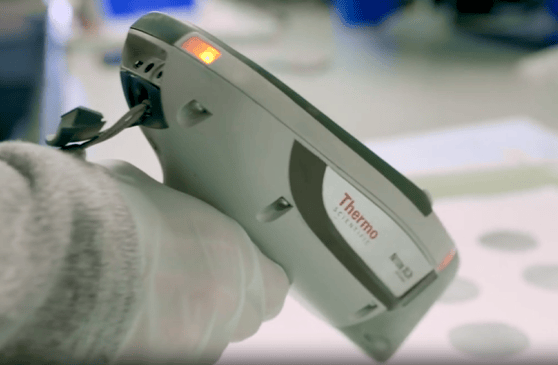
XRF is another widely used non-destructive measurement technique. XRF instruments bombard the coating surface with X rays, causing atoms within the material to emit fluorescent energy signatures. By analyzing the emitted signals, the instrument can estimate coating thickness and elemental composition.
XRF works particularly well for metallic coatings and layered structures. However, its effectiveness depends on the coating chemistry and substrate composition.
Magnetic Induction
Magnetic induction gauges measure the distance between a magnetic probe and a ferrous substrate. These systems are commonly used for paint, plating, and thicker non-conductive coatings on steel components.
While magnetic induction is fast and portable, it is generally less effective for ultra thin coatings in the nanometer range.
Ultrasonic Thickness Measurement
Ultrasonic systems use high frequency sound waves to measure coating thickness. The instrument measures the time required for sound waves to reflect back from coating interfaces.
Ultrasonic methods are often better suited for thicker coatings because extremely thin films may fall below the resolution limit of the instrument.
High Accuracy Laboratory Analysis Methods
In applications requiring extremely detailed characterization, laboratory techniques may provide more precise thickness information and additional insight into coating structure and chemistry.
Cross Sectional SEM Analysis
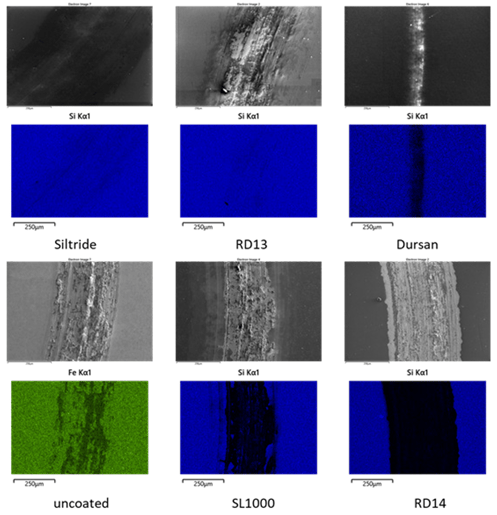
Scanning Electron Microscopy (SEM) is one of the most accurate ways to directly visualize coating thickness. In this method, the coated component is cut, polished, and imaged at very high magnification.
Cross sectional SEM images clearly show the coating layer, substrate interface, and coating uniformity. SEM analysis can also reveal coating defects, voids, or delamination issues that may not be visible with other methods.
The primary disadvantage is that SEM analysis is destructive and typically requires significant sample preparation.
Auger Electron Spectroscopy (AES)
AES is commonly used for extremely thin coatings and surface characterization. This technique measures the elemental composition of the surface while gradually sputtering away material layer by layer.
AES depth profiling allows engineers to evaluate coating thickness, composition, diffusion zones, and interfacial chemistry at the nanometer scale. This makes it particularly useful for analyzing advanced CVD coatings and validating coating uniformity.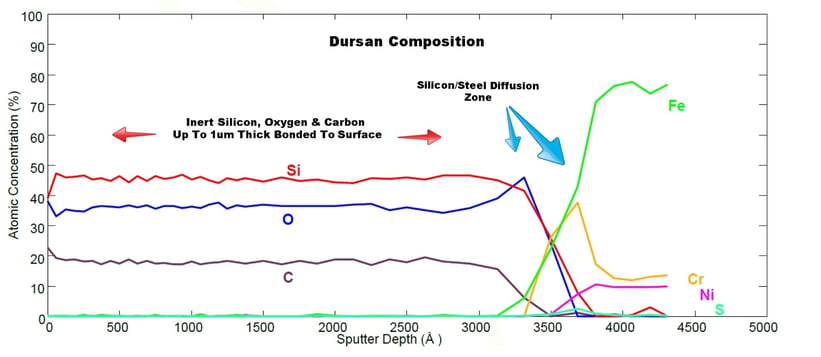
Profilometry
Profilometers physically trace the surface profile of a coated sample using either a stylus or optical sensor. By comparing coated and uncoated regions, the instrument measures the step height created by the coating layer.
Profilometry is often used in research and development environments where highly controlled measurement conditions are available.
Ellipsometry
Ellipsometry is an advanced optical technique that measures changes in polarized light as it reflects from the coating surface. It is highly sensitive to ultra thin films and can provide detailed information about coating thickness and optical properties.
Because ellipsometry relies heavily on optical modeling, it is best suited for relatively smooth and uniform surfaces.
Measuring Complex Geometries
Measuring coating thickness becomes significantly more difficult on internal surfaces, tubing, valves, and complex flow path geometries. Traditional line of sight measurement methods may not accurately represent coating consistency inside narrow passages or high aspect ratio components.
This is especially important for conformal CVD coatings designed to uniformly coat internal surfaces. In these cases, manufacturers often combine multiple measurement methods with process validation data to ensure consistent coating coverage throughout the component.
Thickness Alone Does Not Determine Performance
While coating thickness is important, it is only one factor that determines coating performance. Engineers must also consider:
- Coating adhesion
- Surface chemistry
- Coating uniformity
- Coverage consistency
- Porosity
- Thermal stability
- Corrosion resistance
A coating with excellent thickness control but poor adhesion or incomplete coverage may still fail in demanding applications. This is why advanced coating evaluation often combines thickness measurement with corrosion testing, surface analysis, and application specific performance testing.
Selecting the Right Measurement Method
The best coating thickness measurement method depends on several factors, including:
- Coating material
- Substrate composition
- Part geometry
- Required accuracy
- Production speed
- Whether destructive testing is acceptable
In many cases, manufacturers use a combination of non-destructive screening methods and detailed laboratory analysis to fully characterize coating performance.
As thin film coatings continue to improve the performance of analytical, semiconductor, energy, and life science systems, accurate metrology becomes increasingly important. Reliable coating thickness measurement helps ensure coating consistency, preserves critical tolerances, and validates long term coating reliability in demanding applications.
Want to learn more about how SilcoTek coatings are characterized and tested? Contact our experts!