When an analytical system takes too long to stabilize, it is easy to assume the analyzer itself is the problem. But the delay may begin long before the sample ever reaches the detector.
Every surface a sample contacts along the way, including tubing, valves, fittings, filters, regulators, and sample cylinders, has the potential to interact with the compounds being measured. For reactive or trace level analytes, those interactions can result in adsorption, delayed response, sample loss, and memory effects.
In other words, your analyzer may be ready for the sample long before the sample is ready for the analyzer.
Understanding how surface adsorption affects response time helps laboratories and process operators identify hidden sources of delay and design a more reliable analytical flow path.
What Is Surface Adsorption?
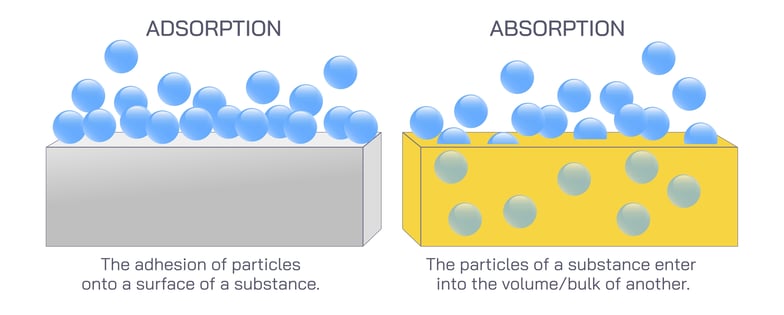
Adsorption (which is different than absorption) occurs when molecules from a gas or liquid adhere to the surface of a material. In an analytical flow path, this means some of the analyte can be temporarily retained by the tubing or other components instead of traveling directly to the detector.
This becomes especially important when measuring reactive compounds or very low concentrations. At trace levels, even relatively small surface interactions represent a meaningful portion of the total analyte being measured.
Bare stainless steel is widely used in analytical systems because of its strength, durability, and temperature capabilities. However, its surface can contain active sites that interact with certain compounds.
When a sample enters an untreated stainless steel flow path, molecules can adsorb onto those sites. As those sites become occupied, progressively more analyte can make its way through the system. The result can be a gradual increase in measured concentration rather than an immediate, stable response.
That is where response time becomes a surface problem.
Adsorption Can Make Stabilization Take Much Longer
One of the clearest examples comes from research conducted as part of the European Metrology Research Programme project focused on metrology for VOC indicators in air pollution and climate change.
Researchers evaluated the adsorption of methanol using 10 meter lengths of stainless steel tubing. Low concentrations of methanol were passed through both uncoated and SilcoNert® 2000 coated stainless steel tubing.
The difference was significant.
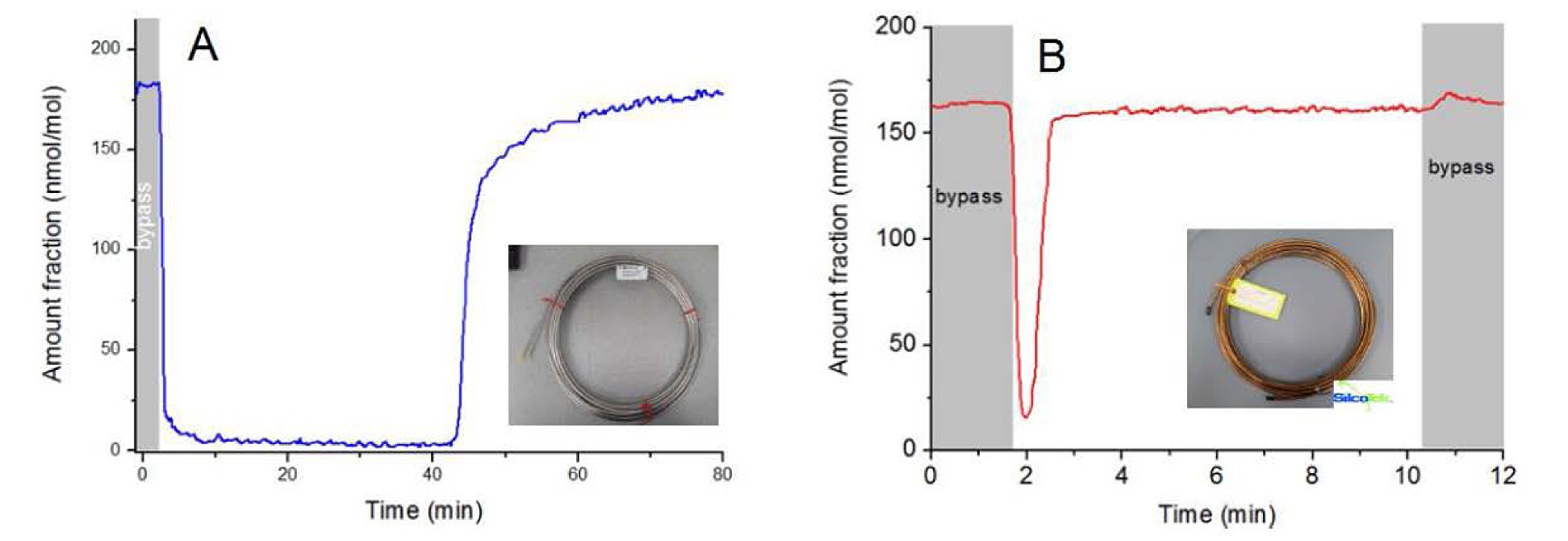
With the uncoated stainless steel tubing, the researchers reported that it took approximately 40 minutes before methanol reached the measurement cell. After that initial delay, another approximately 40 minutes were required for the concentration to stabilize.
With SilcoNert 2000 coated tubing, the methanol concentration stabilized in approximately one minute.
The researchers concluded that methanol adsorption was much lower in the SilcoNert 2000 coated tubing than in the uncoated stainless steel tubing.
For an analytical system, that difference is about more than convenience. Waiting for a surface to equilibrate increases analysis time and make it more difficult to determine whether a changing signal represents the actual sample or interactions occurring somewhere within the sampling system.
The Problem Doesn't End When the Sample Stops
Adsorption affects both sides of an analytical measurement.
When analyte molecules adhere to a surface, they may later desorb or release from that surface. This causes the analyte to remain in the flow path even after the sample concentration has changed.
This behavior can contribute to what is often called a memory effect. The system essentially retains part of a previous sample and releases it over time.
That means an adsorptive flow path can potentially cause two different problems:
A slow rise in signal as the surface initially retains analyte, and a slow return to baseline as previously adsorbed molecules are released.
Both can increase the amount of time required between measurements and complicate interpretation of the analytical signal.
Ammonia Testing Demonstrates Both Effects
Testing with ammonia provides a useful example of how surface chemistry affects both initial response and recovery.
In testing comparing PTFE, 316L stainless steel, and SilcoNert 2000 coated 316L stainless steel sampling lines, the average ammonia rise times were:
SilcoNert 2000 coated 316L: 8.4 seconds
PTFE: 16.2 seconds
316L stainless steel: 17.0 seconds
The differences became even more pronounced when researchers measured fall time, or how quickly the system released the ammonia and returned toward baseline:
Intrinsic analyzer response: 6.0 seconds
SilcoNert 2000 coated 316L: 9.4 seconds
PTFE: 18.2 seconds
316L stainless steel: 33.0 seconds
The coated stainless steel flow path approached the response of the analyzer itself much more closely than either of the other tested sampling materials.
This highlights an important distinction when troubleshooting analytical response. The instrument may be capable of responding quickly, but the components transporting the sample can introduce additional delays.
Reactive Sulfur Compounds Can Create Even Larger Delays
Highly reactive sulfur compounds present another challenging example.
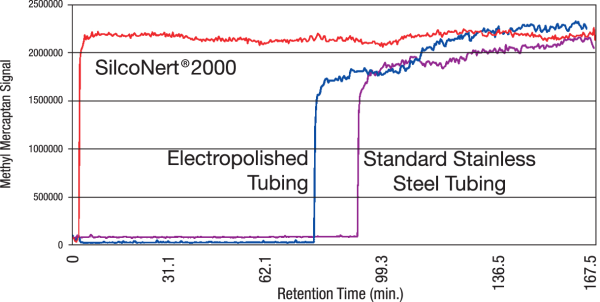
A trace methyl mercaptan sample was passed through 100 feet of 1/8 inch tubing. With untreated stainless steel tubing, more than 90 minutes passed before the detector responded.
The delay was attributed to retention of the sulfur compound by the stainless steel surface.
For process analytical applications, delays on that scale can be especially problematic. If the composition of a process stream changes, the value of the measurement depends partly on how quickly the analytical system accurately detects that change.
A delayed signal may describe what was happening in the process many minutes earlier rather than what is happening at that moment.
Why Trace Analysis Makes Surface Chemistry More Important
Surface adsorption isn't necessarily equally important in every analytical application.
As concentrations decrease, however, the amount of analyte lost to the surface becomes increasingly important relative to the total amount available for measurement.
This is one reason flow path materials deserve greater attention in applications involving trace VOCs, sulfur compounds, ammonia, moisture, and other reactive species.
A component that appears insignificant in a high concentration application may become an important source of adsorption when measurements move from percent levels to ppm or ppb concentrations.
Surface area matters as well. Long tubing runs and components with relatively large internal surface areas, such as filters, can provide more opportunities for the sample to interact with the flow path.
Don't Stop at the Tubing
Changing the tubing while ignoring the rest of the sample path can leave other sources of adsorption in place.
An analytical flow path may include:
- Tubing
- Valves
- Fittings
- Filters and frits
- Regulators
- Sample cylinders
- Probes
- Other wetted components
Each represents another surface the sample encounters before reaching the detector.
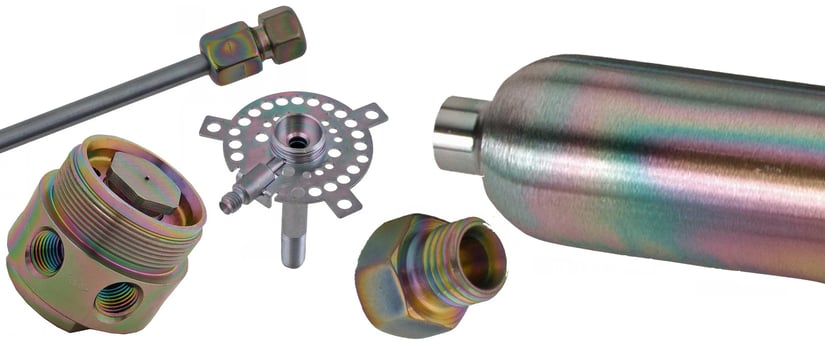
Fritted filters can be particularly important because their structure creates a relatively large surface area. Regulators, valves, fittings, and the internal surfaces of sample cylinders can also retain reactive compounds.
For this reason, improving analytical response often requires looking at the flow path as a complete system rather than focusing on a single piece of tubing.
How SilcoNert 2000 Changes the Flow Path Surface
SilcoNert 2000 is a silicon based chemical vapor deposited coating designed to create an inert barrier between the sample and the underlying metal substrate.
Rather than replacing stainless steel components with an entirely different material, the coating modifies the surfaces that contact the sample while retaining the mechanical properties of the base component.
SilcoTek's CVD process is also conformal, allowing the coating to be applied to internal surfaces and complex geometries such as tubing, valves, fittings, filters, and sample cylinders.
By reducing interaction between reactive analytes and metal surfaces, an inert flow path reduces adsorption and subsequent desorption.
The result is faster stabilization, faster recovery, and less opportunity for previous samples to influence subsequent measurements.
When a Slow Analyzer May Actually Be a Surface Problem
If an analytical system is experiencing slow stabilization, delayed response, persistent signals after a sample has changed, or unexpected carryover between measurements, the detector shouldn't necessarily be the only component under investigation.
The problem may be happening upstream.
Ask where the sample travels before reaching the analyzer. Consider how much surface area it encounters, what those surfaces are made from, and whether the compounds being measured are likely to interact with them.
Testing has demonstrated differences ranging from seconds to tens of minutes depending on the analyte and flow path material. In particularly reactive applications, the difference can be even greater.
Ultimately, an analyzer can only measure the sample that reaches it.
Creating an inert flow path helps ensure that the sample arriving at the detector more accurately represents the sample that entered the system in the first place.
Have questions about how your flow paths can be protected? Contact our knowledgeable technical service team!