When engineers are looking to improve the performance of metal components, they often encounter two broad categories of solutions: surface treatments and coatings. Although these terms can sometimes be used interchangeably, they are fundamentally different technologies with different purposes, limitations, and performance characteristics.
Understanding those differences can help you choose the right solution for your application, whether your priority is corrosion resistance, wear resistance, cleanability, or creating an inert surface for analytical and process applications.
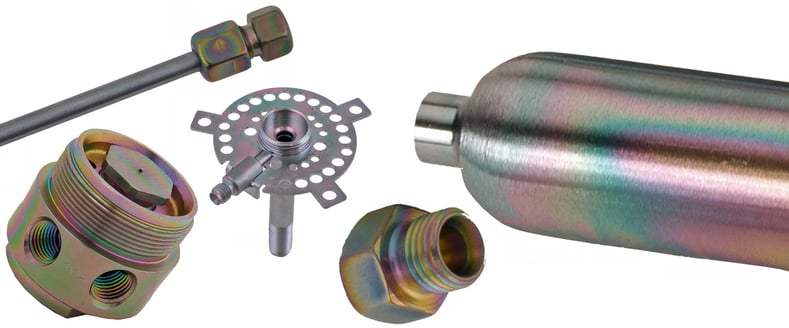
What Is a Surface Treatment?
A surface treatment modifies the existing surface of a material rather than adding a new one. These processes change the chemistry, structure, or texture of the metal itself to improve a specific property.
Common surface treatments include:
- Passivation
- Electropolishing
- Anodizing
- Heat treatments
- Abrasive Blasting
- Shot Peening
- Nitriding and carburizing
Each process alters the substrate in some way. For example, passivation removes free iron from stainless steel to improve corrosion resistance, while electropolishing smooths microscopic surface roughness by removing a thin layer of metal.
Surface treatments can improve durability and cleanliness, but they cannot fundamentally change the chemical nature of the underlying material.
What Is a Coating?
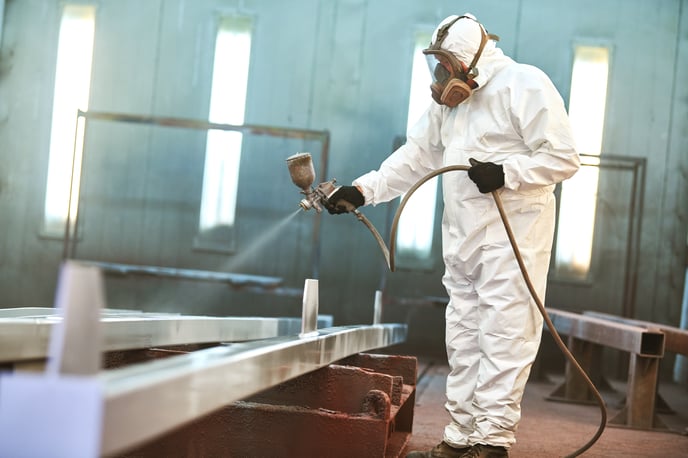
Unlike a surface treatment, a coating creates a new engineered surface on top of the original material.
Traditional coatings, such as paint, powder coating, or electroplating, add a protective layer that serves as a barrier between the substrate and its environment. Depending on the application, coatings can provide corrosion resistance, wear resistance, or decorative finishes.
However, not all coatings are created equal.
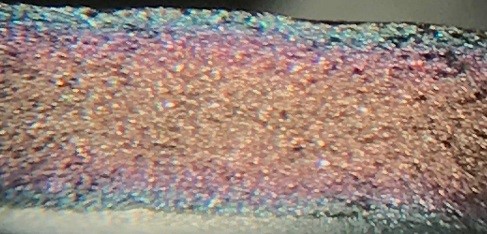 This example shows a cross-section of a frit that has been coated with a SilcoTek coating. The coating adsorbs onto the substrate to create a thin, uniform barrier.
How SilcoTek Coatings Are Different
SilcoTek coatings are applied using chemical vapor deposition (CVD), creating an ultra-thin, conformal barrier that becomes chemically bonded to the surface.
Rather than simply covering the part, the coating adheres to every feature of the substrate, including complex internal flow paths, tubing, valves, fittings, and intricate components.
Because the coating is measured in microns instead of mils, it maintains critical dimensions and tight tolerances while providing a new surface chemistry.
The result is a surface that can be:
Instead of changing the stainless steel itself, SilcoTek creates a new functional surface engineered for the environment in which the component will operate.
Comparing Surface Treatments and SilcoTek Coatings
| Surface Treatments |
SilcoTek Coatings |
| Modify the existing metal surface |
Create an entirely new engineered surface |
| Improve specific surface characteristics |
Deliver multiple performance improvements simultaneously |
| Limited by the properties of the base metal |
Surface chemistry is engineered independently of the substrate |
| May improve corrosion resistance or finish |
Can provide inertness, corrosion resistance, cleanability, and low adsorption |
| Typically remove or alter existing material |
Add an ultra-thin conformal barrier through CVD |
| Performance depends on substrate composition |
Performance comes from the engineered coating surface |
Why Surface Treatments Aren't Always Enough
Many applications begin with a traditional surface treatment such as electropolishing or passivation. These processes certainly have value, especially for improving corrosion resistance or surface finish.
However, the underlying stainless steel is still stainless steel.
Reactive compounds can still adsorb onto active metal sites. Corrosive chemicals can still attack the substrate under aggressive conditions. Trace-level analytical measurements may still suffer from sample loss or inconsistent results.
For industries that depend on accurate measurements or extremely clean process surfaces, modifying the existing metal often isn't sufficient.
A new engineered surface may be required.
Choosing the Right Solution
Surface treatments remain an excellent choice for many industrial applications. They are well established, cost effective, and can significantly improve the performance of stainless steel components.
But when the application requires an inert flow path, protection from aggressive chemicals, improved sample recovery, or contamination control, a surface treatment alone may not achieve the desired performance.
That's where engineered CVD coatings provide a distinct advantage. By creating a new functional surface without changing component dimensions or geometry, SilcoTek coatings allow researchers and manufacturers to improve the performance of existing components while maintaining the precision their applications demand.
Engineered Surfaces for Demanding Applications
At SilcoTek, we don't simply improve the metal that's already there, we engineer an entirely new surface designed for your application.
Whether you're analyzing trace sulfur compounds, handling corrosive process streams, manufacturing pharmaceuticals, or protecting components in semiconductor systems, the right surface can dramatically improve performance, reliability, and product quality.
Understanding the difference between a surface treatment and an engineered coating is the first step toward selecting the best solution for your process.
Have questions about your application and how our coatings can help? Please reach out to our team!