If you have worked with analytical sampling systems or gas chromatography equipment, you may be familiar with names such as SilcoNert®, Sulfinert®, Silcosteel®, and Siltek®. Although these names are closely related, they do not all describe the same coating.
Some are current SilcoTek coating names, while others are legacy names that originated when we were at Restek®, still used by customers, equipment suppliers, analytical methods, and industry standards. Understanding how the names relate can make it easier to specify the right coating for a new application or replace an existing coated component.
Why Inert Flow Paths Matter
Stainless steel is commonly used throughout analytical and process systems because of its strength, temperature resistance, and general chemical compatibility. However, its surface can interact with reactive compounds such as hydrogen sulfide, other sulfur species, mercury, and ammonia.
These interactions may cause analyte adsorption, delayed response, calibration problems, carryover, or inaccurate measurements. The effects become especially important when testing at trace concentrations because even a small amount of analyte loss can significantly affect the result.
SilcoTek applies thin, silicon based coatings by chemical vapor deposition, or CVD, to create a barrier between the sample and the underlying metal. Because the process is non line of sight, it can coat internal passages and complex component geometries throughout the analytical flow path.
The Short Explanation
The easiest way to understand the terminology is to connect the legacy coating names to the current SilcoTek names:
| Current SilcoTek name |
Legacy or related name |
Primary purpose |
| SilcoNert 1000 |
Silcosteel |
General purpose amorphous silicon barrier |
| SilcoNert 2000 |
Sulfinert and Siltek |
Enhanced inertness for reactive compounds and trace analysis |
Silcosteel refers to the original silicon coating technology that evolved into SilcoNert 1000. Sulfinert and Siltek refer to the functionalized coating technology now offered by SilcoTek as SilcoNert 2000.
These older names may still appear in product catalogs, established analytical methods, purchase specifications, and customer documentation.
What Is SilcoNert 1000?
SilcoNert 1000 is a hydrogenated amorphous silicon coating designed to form a chemically protective barrier over the substrate. It is the modern SilcoTek name associated with the original Silcosteel technology.
The coating helps prevent contact between process media and reactive metal surfaces. It can be useful for general barrier applications, high temperature service, and applications where a chemically pure silicon surface is preferred.
According to the current SilcoNert 1000 data sheet, the coating is stable at temperatures up to 600°C and is typically applied at a thickness of 100 to 500 nanometers.
SilcoNert 1000 may be appropriate when:
- A general purpose silicon barrier is needed
- High temperature stability is important
- Preventing substrate interaction or metal contamination is the primary goal
- The application does not require the highest level of inertness for reactive trace compounds
What Is SilcoNert 2000?
SilcoNert 2000 begins with an amorphous silicon barrier that is further functionalized to create a highly inert surface. It was previously known as Sulfinert and Siltek.
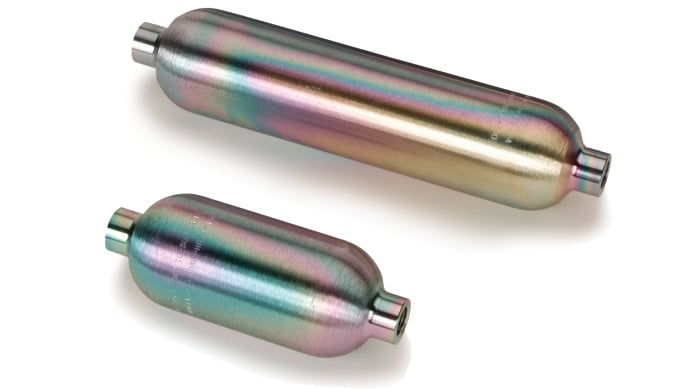
Siltek was originally associated primarily with gas chromatography inlet liners. Sulfinert applied the same general inert coating technology to a wider range of flow path components, including tubing, valves, fittings, regulators, and sample cylinders. When SilcoTek became an independent company, this coating technology was renamed SilcoNert 2000.
SilcoNert 2000 is designed for applications involving reactive compounds or trace level measurements. It is commonly used to improve the recovery and response of sulfur compounds, mercury, ammonia, and other active analytes.
The SilcoNert 2000 data sheet identifies a typical coating thickness of 100 to 500 nanometers and a maximum functionalization temperature of 400°C in oxidative environments or 450°C in inert environments.
SilcoNert 2000 is generally the preferred option when:
- Measuring reactive compounds at trace concentrations
- Reducing adsorption throughout an analytical flow path
- Faster calibration and sample response are important
- Minimizing system priming, carryover, or retesting is a priority
- Reliable recovery of sulfur, mercury, ammonia, or similar compounds is required
SilcoNert 1000 vs. SilcoNert 2000
Both coatings are applied by thermal CVD and form thin, conformal barriers over compatible substrates. The main difference is the surface chemistry and the level of inertness it provides.
SilcoNert 1000 is a general purpose amorphous silicon barrier. SilcoNert 2000 adds a functionalized surface that provides greater inertness toward reactive compounds.
For most gas chromatography and trace chemical analysis applications, SilcoNert 2000 is the more appropriate choice. SilcoNert 1000 may be preferred when the application requires a pure silicon surface, greater high temperature stability, or general isolation of the substrate rather than enhanced trace analyte recovery.
Where Does Silcolloy Fit?
Silcolloy® (previously named Silcosteel-CR) is another amorphous silicon coating, but it should not be treated simply as another name for SilcoNert 1000. Silcolloy uses a multilayer coating structure designed to provide a thicker protective barrier.
It is commonly considered for corrosion resistance, high purity processes, and applications where preventing contamination from the underlying substrate is important. Selecting between Silcolloy, SilcoNert 1000, and SilcoNert 2000 depends on whether the primary challenge is corrosion, substrate isolation, temperature, or chemical inertness.
Why Are the Older Names Still Used?
Legacy coating names often remain in the industry long after product branding changes. Analytical methods, engineering specifications, instrument documentation, and purchasing systems may continue to reference Silcosteel, Sulfinert, or Siltek.
Restek also continues to use traditional coating names for certain products coated by SilcoTek. As a result, a customer purchasing a Sulfinert treated component may be receiving the coating technology that SilcoTek calls SilcoNert 2000.
Recognizing this relationship helps prevent confusion when replacing parts or updating a system specification.
Many of our approved partners sell coated parts.
How to Select the Right Coating
Start by identifying the primary surface problem:
- For reactive or trace level analytes, SilcoNert 2000 is generally the best starting point.
- For a general purpose silicon barrier or higher temperature service, consider SilcoNert 1000.
- For a thicker corrosion resistant or contamination control barrier, consider Silcolloy.
Actual coating performance can depend on the sample chemistry, concentration, temperature, pressure, moisture, component design, and cleaning procedures. SilcoTek’s technical service team can review these conditions and recommend the most appropriate option.
How to Order Coated Components
SilcoTek is a coating service provider and does not manufacture the parts it coats. Customers can send eligible components to SilcoTek for custom coating or purchase already coated products from an approved supplier.
For custom tubing, valves, fittings, sample cylinders, and other flow path components, contact SilcoTek to request a coating quote. If you need standard chromatography products, Restek and other approved SilcoTek partners offer a variety of coated components.
The Bottom Line
Silcosteel is the legacy name associated with SilcoNert 1000, while Sulfinert and Siltek are associated with the technology now called SilcoNert 2000.
The names share a common history, but the two current SilcoNert coatings serve different purposes. SilcoNert 1000 provides a general purpose amorphous silicon barrier, while SilcoNert 2000 provides enhanced inertness for reactive compounds and trace analytical measurements.
Choosing the coating based on the application, rather than the familiarity of an older name, helps ensure better sample recovery, faster response, and more reliable analytical results.