In many industrial, scientific, and medical systems, performance limitations don’t come from the bulk material, they originate at the surface. Corrosion, chemical attack, adsorption, contamination, and thermal degradation all begin where a material interacts with its environment. Barrier coatings are designed to control that interaction.
A barrier coating is an engineered surface layer applied to a component to limit or prevent the transfer of substances or energy - such as moisture, gases, chemicals, heat, or radiation - between the environment and the underlying substrate. By isolating the surface from aggressive conditions, barrier coatings extend component life, improve reliability, and enable materials to perform in environments they could not otherwise tolerate.
Almost all coatings can be considered “barrier coatings” in some form. Historically, barrier coatings were designed to provide basic protection against corrosion, moisture, or heat under relatively moderate conditions. As industrial processes have evolved - becoming hotter, more chemically aggressive, and more sensitive to contamination - the limitations of traditional barrier coatings have become more apparent. This has driven the development of modern thin-film barrier coatings designed specifically for today’s demanding environments.
How Barrier Coatings Work
Barrier coatings function by creating a low-permeability interface between a surface and its surroundings. Depending on the coating chemistry and structure, this interface can slow diffusion, block chemical reactions, or shield the substrate from thermal or environmental stress.
The effectiveness of a barrier coating is determined by a combination of factors: how well it adheres to the substrate, how resistant it is to the surrounding environment, and how uniformly it covers the surface. Even microscopic defects or pinholes can compromise performance, particularly in high-purity or corrosive applications.
Barrier coatings are commonly engineered to resist moisture ingress, limit gas diffusion, prevent chemical attack, reduce oxidation, insulate against heat, or protect against UV exposure. In many cases, a single coating is designed to address several of these challenges simultaneously.
Key Properties of Barrier Coatings
Although barrier coatings vary widely in composition, they share a common purpose: controlling surface interaction. In practice, this means minimizing permeability while maintaining stability under real-world operating conditions. Chemical inertness is often critical in corrosive or high-purity systems, while thermal stability becomes essential at elevated temperatures. Mechanical durability and adhesion ensure that the coating continues to perform over time without cracking, delaminating, or wearing away.
The relative importance of each property depends on the application. A coating optimized for moisture resistance in packaging will differ significantly from one designed to withstand aggressive solvents or high-temperature process gases.
Types of Barrier Coatings
Barrier coatings can be broadly categorized by material type and deposition method. Each category offers distinct advantages and limitations.
- Traditional Polymer Barrier Coatings
Polymer-based barrier coatings are widely used due to their versatility and chemical resistance. Materials such as fluoropolymers, epoxies, and parylenes can form continuous films that protect against moisture, gases, and many chemicals. These coatings are often chosen for applications requiring conformal coverage over complex geometries and moderate operating temperatures. However, polymers may have limitations in extreme thermal environments or when exposed to particularly aggressive solvents, where swelling or degradation can occur.
- Traditional Ceramic and Oxide Barrier Coatings
Ceramic barrier coatings provide excellent resistance to heat, wear, and chemical attack. Oxides such as alumina or zirconia are commonly used in environments where polymers would fail due to temperature or abrasion. Because ceramics are inherently rigid and brittle, they are best suited for applications where mechanical stress is well controlled. In high-temperature systems, such as turbines or engines, ceramic barrier coatings are often used as part of multilayer thermal barrier systems to insulate underlying materials from extreme heat.
- Traditional Metallic Barrier Coatings
Metallic coatings, including nickel, chromium, and aluminum-based layers, are frequently used for corrosion protection and mechanical durability. These coatings can perform well in controlled environments and are commonly applied in industrial and structural applications. In chemically aggressive or high-purity systems, however, metallic coatings may be less suitable due to potential corrosion, ion release, or contamination concerns. In such cases, additional surface treatments or alternative barrier technologies are often required.
- Modern Thin-Film and Vapor-Deposited Barrier Coatings
Thin-film barrier coatings applied via vapor deposition techniques, such as chemical vapor deposition (CVD), like SilcoTek, or physical vapor deposition (PVD), offer a unique combination of uniformity and performance. These coatings can be applied at micron- or nanometer-scale thicknesses while maintaining excellent adhesion and extremely low permeability. Because vapor-deposited coatings are highly conformal, they are particularly effective on complex geometries and internal surfaces where traditional coatings struggle to provide consistent coverage. Their minimal thickness also means they have little impact on component dimensions or tolerances, making them well suited for precision systems.
While traditional barrier coatings continue to serve important roles, many rely on thickness rather than uniformity to provide protection. Spray-applied and bulk coatings can suffer from pinholes, uneven coverage, poor adhesion on complex geometries, and reduced performance on internal surfaces. In high-purity or highly corrosive environments, these limitations can lead to premature failure, contamination, or inconsistent performance.
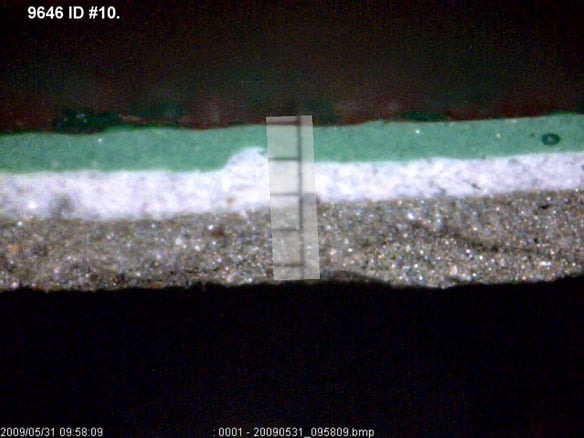 For example, in this cross-section of our coating, the green layer is SilcoTek's coating that adheres to the surface, creating a barrier to harsh environments.
Selecting the Right Barrier Coating
Choosing the appropriate barrier coating requires a clear understanding of the operating environment and performance requirements. Temperature, pressure, chemical exposure, cleanliness standards, mechanical stress, and substrate compatibility all play a role in determining which coating technology will perform best.
A coating that excels at blocking moisture may not withstand high heat, and a coating designed for extreme temperatures may be unnecessary or impractical in lower-stress environments. Successful coating selection balances performance needs with material compatibility and long-term reliability.
Why Barrier Coatings Matter
Barrier coatings are more than protective layers - they are enabling technologies. By controlling surface interactions, they allow components to operate longer, more reliably, and in more demanding environments. In advanced industrial, analytical, and scientific systems, the right barrier coating can mean the difference between routine maintenance and unexpected failure.
As processes become more aggressive and performance requirements continue to rise, barrier coatings will remain a critical tool for extending material capability and ensuring consistent system performance.
While traditional barrier coatings rely on bulk material properties and thickness for protection, modern thin-film barrier coatings are engineered at the surface level to deliver consistent, high-performance barriers under the most demanding conditions.
Contact our team today for more information on SilcoTek's CVD barrier coatings!