In biopharmaceutical, food and beverage, and life sciences manufacturing, equipment surfaces must withstand demanding conditions while supporting process integrity. Corrosion, chemical interactions, and material buildup can affect product quality and equipment reliability. SilcoTek's chemical vapor deposition (CVD) surface technologies help address these challenges by modifying critical component surfaces.
SilcoTek's Siltride® 1000, Notak® 2000, and Dursan® coatings have all passed ISO 10993-5 cytotoxicity testing. These results provide additional information for manufacturers evaluating materials used in sensitive applications. They complement the coatings' established corrosion resistance, inertness, and wettability characteristics.
What ISO 10993-5 Cytotoxicity Results Mean and Why They Matter
ISO 10993-5 is an internationally recognized standard that evaluates whether a material or substances released from it damage or kill living cells in a controlled laboratory environment. Cytotoxicity testing examines cellular responses such as cell viability, growth, and morphology following exposure to the test material or its extract. Passing this test demonstrates that the material does not cause significant cell death or inhibit cell growth to a cytotoxic level under the evaluated conditions.
For biopharmaceutical, food and beverage, and life sciences manufacturers, these results are particularly meaningful because equipment surfaces may come into contact with substances that eventually enter the human body or originate from it. Whether manufacturing pharmaceutical products, processing food and beverages, or handling biological samples, minimizing the introduction of potentially harmful substances from equipment surfaces is an important consideration. Selecting materials with documented noncytotoxic properties can help support product safety, purity, and material qualification efforts.
With Siltride 1000, Notak 2000, and Dursan all passing ISO 10993-5 testing, manufacturers can evaluate these surface technologies with greater confidence in their biological compatibility under the tested conditions. These results complement the coatings' ability to protect underlying metal surfaces, reduce unwanted chemical interactions, and improve equipment performance. While cytotoxicity testing is one component of a broader biological evaluation, it provides valuable supporting evidence for applications where material safety and product integrity are priorities.
Siltride 1000: Superior Corrosion Resistance for Demanding Processing Environments
Siltride 1000 provides exceptional corrosion resistance through a protective silicon oxynitride barrier between process chemicals and the underlying metal. This protection is particularly valuable when stainless steel components encounter aggressive acids, cleaning chemicals, or other corrosive environments. By limiting surface deterioration, Siltride can help reduce corrosion-related maintenance and protect critical equipment surfaces.
Corrosion presents challenges in biopharmaceutical and life sciences manufacturing, where deteriorating metal surfaces can introduce unwanted contaminants or compromise equipment reliability. Siltride helps protect compatible stainless steel components without requiring manufacturers to replace existing materials with more expensive specialty alloys. Its combination of chemical resistance and durability makes it a compelling option for demanding processing applications.
Proven Corrosion Resistance Against Aggressive Chemicals
SilcoTek's testing demonstrates Siltride 1000's ability to protect stainless steel in highly corrosive environments. In one study, Siltride-coated 316L stainless steel exposed to 18.5% hydrochloric acid for seven days exhibited an average corrosion rate of approximately 4.7 mils per year (mpy), compared with approximately 163 mpy for uncoated stainless steel. This represents roughly a 35-fold improvement in corrosion resistance under the tested conditions.
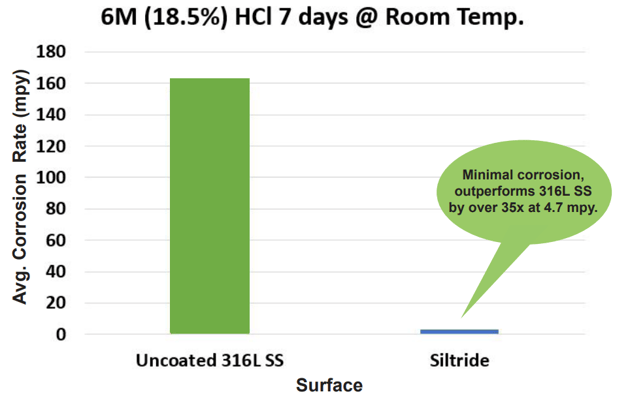 Siltride 1000 demonstrated approximately 35x greater corrosion resistance than uncoated 316L stainless steel following seven days of exposure to 18.5% hydrochloric acid at room temperature.
Additional testing in 5% hydrochloric acid at 80°C demonstrated more than 55 times lower corrosion rates for Siltride-coated stainless steel compared with uncoated 316L stainless steel over seven hours. These results further illustrate the coating's protective capabilities under aggressive chemical exposure. Although performance depends on the specific application, the findings demonstrate Siltride's potential for improving component durability in challenging processing environments.
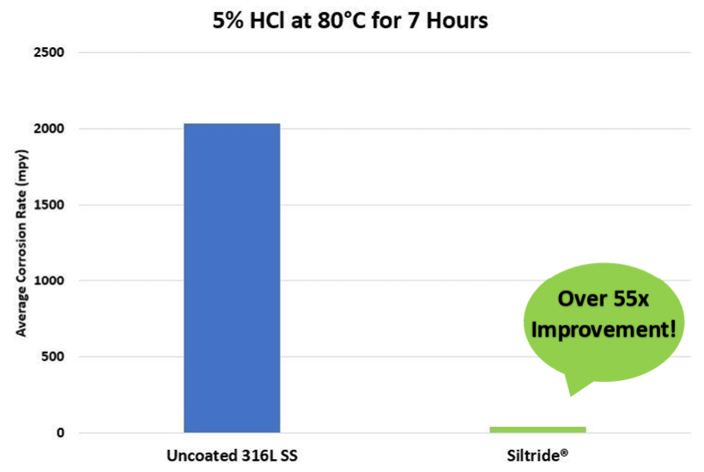 Siltride 1000 demonstrated more than 55 times greater corrosion resistance than uncoated 316L stainless steel during seven hours of exposure to 5% hydrochloric acid at 80°C.
Beyond corrosion protection, Siltride offers hydrophilic surface characteristics that can be beneficial in applications where wettability is important. This provides manufacturers with another consideration when selecting coatings for specific fluid handling requirements. Combined with successful ISO 10993-5 cytotoxicity testing, Siltride offers a valuable combination of corrosion resistance, surface performance, and supporting biological evaluation data.
Notak 2000: Hydrophobic Protection for Sensitive Applications
Notak 2000 provides a low-energy, hydrophobic surface designed to reduce liquid wetting and adhesion. These characteristics can benefit compatible fluid handling components where unwanted surface retention or liquid adhesion affects performance. Its surface properties offer manufacturers an alternative to conventional untreated metal surfaces.
In biopharmaceutical and life sciences applications, controlling how fluids interact with equipment surfaces can be important for maintaining consistent processing conditions. Notak modifies these interactions without requiring changes to the underlying component material. Its successful ISO 10993-5 cytotoxicity testing provides additional supporting information for manufacturers evaluating the coating for sensitive applications.
Dursan: Versatile Protection for Food Processing and Life Sciences
Dursan combines corrosion resistance, chemical inertness, and hydrophobic surface properties to protect components used in demanding environments. Its protective barrier helps reduce interactions between process materials and underlying metal surfaces while limiting unwanted adhesion. These characteristics make Dursan relevant to applications involving sensitive compounds, chemical exposure, and challenging cleaning requirements.
In food and beverage manufacturing, corrosion and material buildup can increase cleaning demands and contribute to equipment deterioration. Biopharmaceutical manufacturers face similar concerns when protecting equipment surfaces and maintaining process integrity. Dursan helps address these challenges by improving the surface characteristics of compatible stainless steel components.
Dursan also has established qualifications relevant to sensitive applications, including USP Class VI testing and NSF/ANSI 51 compliance for applicable food equipment material uses. Its successful ISO 10993-5 cytotoxicity testing adds to this existing performance information. These results provide manufacturers with additional supporting data when evaluating Dursan for food processing, pharmaceutical equipment, and life sciences applications.
Comparing SilcoTek's Surface Technologies
Although Siltride 1000, Notak 2000, and Dursan have all passed ISO 10993-5 testing, their surface properties differ significantly. Siltride offers exceptional corrosion resistance and a hydrophilic surface, while Notak and Dursan provide hydrophobic characteristics for applications where reduced wetting or adhesion is important. Understanding these differences helps manufacturers select the appropriate coating for their operating conditions.
SilcoTek Coating Surface Characteristics
| Coating |
Representative Water Contact Angle |
Surface Characteristic |
| Siltride |
34° |
Hydrophilic |
| Dursan |
121° |
Hydrophobic |
| Notak 2000 |
146° |
Strongly hydrophobic |
Representative contact angle measurements demonstrate the different wettability characteristics of each coating.
SilcoTek's CVD process also enables thin, conformal coatings to be applied to accessible internal and external surfaces of complex components. Unlike traditional line-of-sight coating methods, CVD can protect intricate geometries, including tubing, valves, fittings, and other fluid handling equipment. This allows manufacturers to improve surface performance while maintaining the underlying component material and design.
New Testing Supports Material Selection in Sensitive Industries
Material compatibility, corrosion resistance, and product purity are essential considerations in biopharmaceutical, food and beverage, and life sciences manufacturing. With Siltride 1000, Notak 2000, and Dursan successfully passing ISO 10993-5 cytotoxicity testing and exhibiting no detectable nonvolatile extractables above the LC-MS reporting threshold under the evaluated USP <665> conditions, SilcoTek offers manufacturers additional evidence of both biological compatibility and chemical stability. Combined with the superior corrosion resistance of Siltride and the established surface protection capabilities of Dursan and Notak 2000, these results demonstrate the potential for SilcoTek's surface technologies to help manufacturers maintain product purity, protect critical equipment, and meet increasingly demanding material performance requirements.
Siltride 1000 stands out for its superior corrosion resistance, offering documented protection against aggressive chemicals that can contribute to premature component deterioration. Notak 2000 provides hydrophobic properties for applications requiring reduced wetting and adhesion, while Dursan combines corrosion resistance, inertness, and established industry qualifications. Together, these technologies offer manufacturers multiple options for improving surface performance and equipment reliability.

See the Official Reports:
Siltride 1000
Notak 2000
Dursan
USP 665 Extractables LC-MS Analysis on Silicon Coatings
Learn More About SilcoTek's Surface Solutions
SilcoTek's technical team can help evaluate coating options based on chemical exposure, operating conditions, and surface performance requirements. Whether the priority is corrosion protection, hydrophobicity, or material compatibility, selecting the right coating can improve component performance in demanding applications.
Contact SilcoTek to learn more about the new ISO 10993-5 cytotoxicity testing results and determine which coating best fits your application.