Choosing the right inert coating plays a major role in maintaining sample integrity, improving analytical accuracy, and extending the life of critical components. Two of the most commonly specified options are SilcoNert® 1000 and SilcoNert® 2000. While they share a similar silicon-based foundation, they are designed to solve different performance challenges.
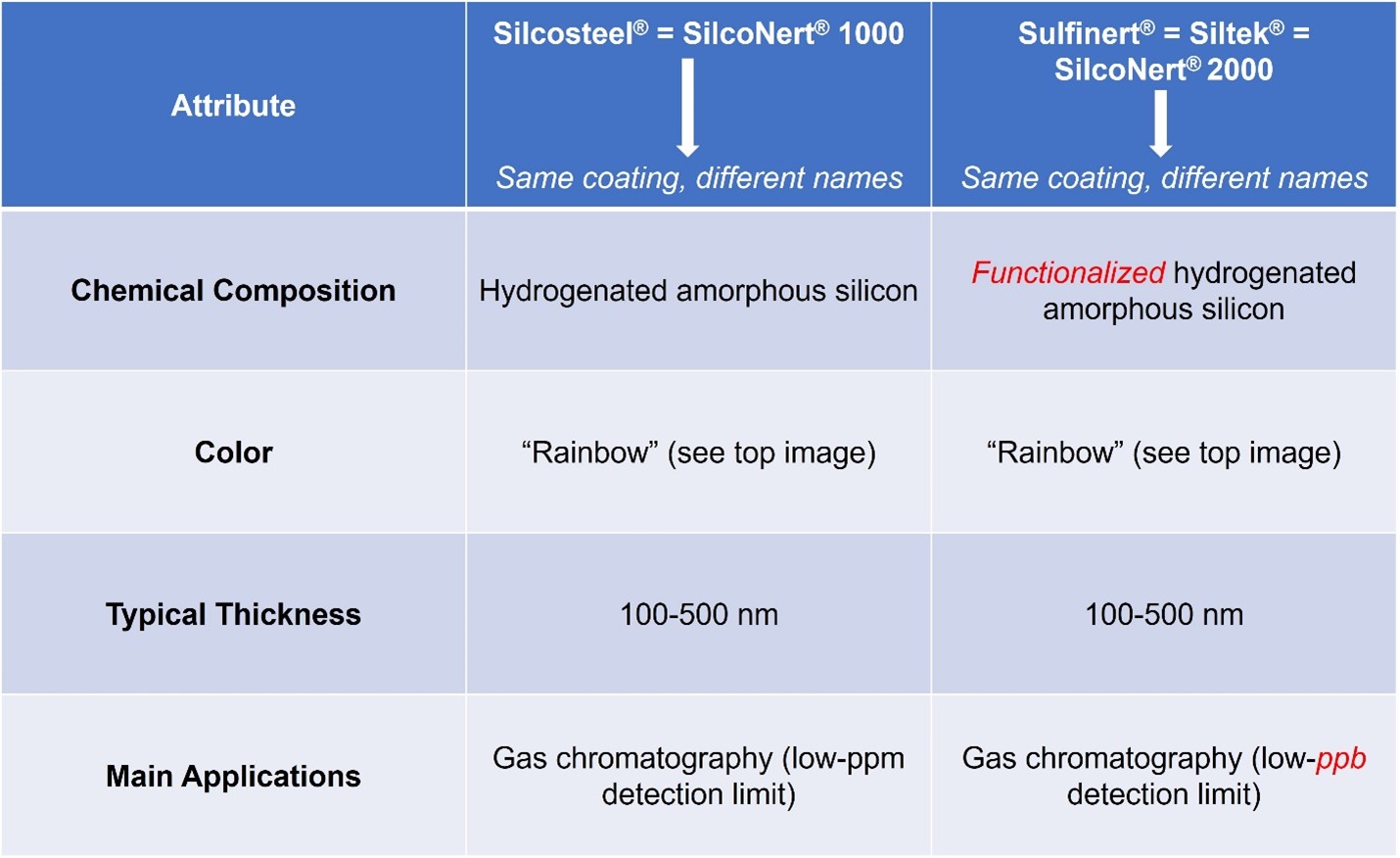
Some users may still recognize these coatings by earlier names. SilcoNert 1000 was previously referred to as Silcosteel® (a trademark from our humble beginnings at Restek®), while SilcoNert 2000 evolved from Sulfinert® and Siltek®. Today, the SilcoNert naming reflects a more unified product line, but the underlying differences remain the same.
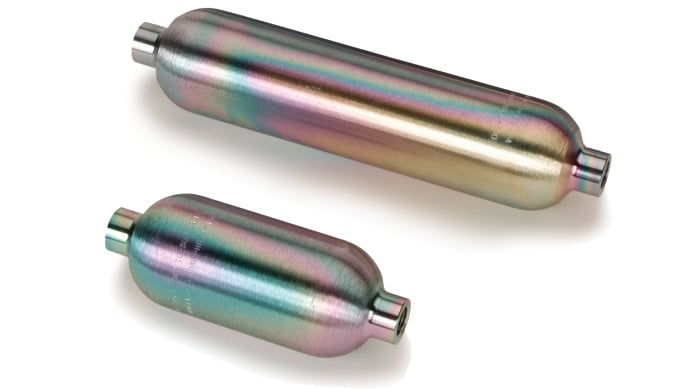 SilcoNert 2000 coated sample cylinders.
What Do SilcoNert 1000 and 2000 Have in Common?
Both coatings are applied using chemical vapor deposition (CVD), forming a thin, conformal silicon barrier that is molecularly bonded to the metal surface. This creates a metal-free surface that reduces reactivity, helping prevent corrosion, adsorption, and contamination.
Because the coating is applied at the molecular level, it maintains tight tolerances and preserves component geometry. This is critical for flow paths, valves, and analytical systems where precision directly impacts performance.
SilcoNert 2000: Engineered Surface Chemistry for Ultra-Inert Performance
SilcoNert 2000 is designed specifically to minimize surface interactions. While the bulk of the coating is composed of amorphous silicon, the surface is further modified with functional groups that reduce surface energy and create a highly inert, hydrophobic barrier.
That surface modification is the key difference.
By lowering surface energy, SilcoNert 2000 prevents reactive compounds from adsorbing onto the walls of the system. Instead of sticking and slowly releasing over time, analytes move cleanly through the flow path and reach the detector without delay.
In practical terms, this means faster response times, improved peak shape, and more accurate measurements. In trace-level applications, especially those involving reactive compounds like sulfur species or mercury, this level of inertness is critical to avoiding analyte loss.
SilcoNert 2000 is widely adopted across analytical, oil and gas, and process sampling applications because it directly addresses the most common source of measurement error, which is surface activity.
SilcoNert 1000: A Simpler Silicon Barrier with Higher Temperature Capability
SilcoNert 1000 provides a more straightforward silicon coating without the additional surface functionalization used in SilcoNert 2000.
Its surface is closer to pure amorphous silicon, which results in a more basic passivation layer. While it still reduces surface reactivity and improves corrosion resistance, it does not offer the same level of inertness because it lacks the engineered surface chemistry that minimizes adsorption.
Where SilcoNert 1000 stands out is thermal stability. It can withstand higher temperatures than SilcoNert 2000, making it better suited for applications that operate beyond typical analytical conditions.
In environments where adsorption is less of a concern, or where analytes are present at higher concentrations, SilcoNert 1000 can provide reliable and durable performance.
The Core Difference
The distinction between the two coatings comes down to surface design.
SilcoNert 2000 includes engineered surface functional groups that actively reduce adsorption and improve inertness.
SilcoNert 1000 relies on a basic silicon barrier that provides passivation but does not actively minimize surface interactions to the same extent.
Both coatings improve performance compared to uncoated metal, but they are optimized for different priorities.
When Should You Use SilcoNert 1000 Instead of 2000?
SilcoNert 2000 is typically the default choice, but there are situations where SilcoNert 1000 is the better fit.
When operating temperatures exceed the limits of SilcoNert 2000, SilcoNert 1000 provides the thermal stability needed to maintain coating performance.
In applications where a simpler surface chemistry is preferred, SilcoNert 1000 avoids the added functional groups that give SilcoNert 2000 its ultra-inert behavior.
For higher concentration environments or less reactive analytes, the additional inertness of SilcoNert 2000 may not be necessary. In these cases, SilcoNert 1000 can deliver sufficient performance without overengineering the solution.
Why SilcoNert 2000 Is Typically Preferred
In most modern analytical systems, accuracy is the limiting factor. Even small amounts of adsorption can delay response times, distort results, and require system conditioning.
SilcoNert 2000 minimizes these effects by reducing surface energy and limiting interaction between the analyte and the flow path. The result is faster response, improved repeatability, and more reliable data, especially at low concentrations.
Final Takeaway
If your priority is accurate, low-level measurement with minimal analyte interaction, SilcoNert 2000 is usually the right choice.
If your application involves higher temperatures or does not require ultra-high inertness, SilcoNert 1000 can be the better option.
Understanding the role of surface chemistry makes it easier to select the right coating for your process, rather than defaulting to a one-size-fits-all solution.
If you have any questions about how our coatings can help in your application, please contact us for a free consultation with our experts!