When contamination shows up in an analytical or semiconductor system, most people look at the usual suspects. Leaks, poor calibration, or dirty components are often the first things to be checked. But there’s another source that tends to go unnoticed because it’s built directly into the system itself: outgassing.
Even in a closed, well-designed system, materials can slowly release trapped gases and contaminants over time. At trace levels, those small releases can have a measurable impact on accuracy, stability, and process control. In many cases, the issue isn’t something entering the system - it’s something coming from within.
What is Outgassing?
Outgassing refers to the release of gases that were previously absorbed, adsorbed, or trapped within a material. In metal flow paths and system components, these gases often include moisture, hydrocarbons, and residual contaminants from manufacturing, cleaning, or prior exposure to process conditions. While these species may not be present in large amounts, they don’t need to be. In modern analytical and semiconductor environments, even extremely small concentrations can influence performance.
Unlike a one-time contamination event, outgassing is continuous. Materials can act like reservoirs, slowly releasing gases back into the system over time. This effect becomes more noticeable as systems are pushed to lower detection limits and tighter process tolerances. What may have been negligible at higher concentrations can become a limiting factor at the ppm, ppb, or even ppt level.
At these low levels, outgassing can introduce a range of challenges. Background noise may increase, making it more difficult to distinguish real signals from system interference. Stabilization times can lengthen as the system works to reach equilibrium. In analytical applications, this can lead to distorted results or reduced confidence in data. In semiconductor processes, even small amounts of contamination can interfere with sensitive reactions or deposition steps, ultimately impacting yield and consistency.
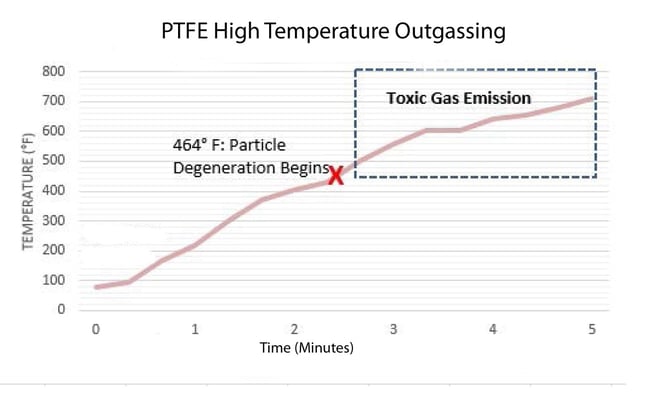
Unlike traditional Teflon® (PTFE) or other PFAS-containing materials that degrade and contaminate systems, SilcoTek coatings do not outgas.
The Frustration of Outgassing
One of the more frustrating aspects of outgassing is that it can occur even when a system appears to be functioning properly. A system may be leak-tight, clean, and correctly assembled, yet still experience performance drift over time. This is because outgassing originates from the materials themselves. Metal tubing, valves, regulators, seals, and other components can all contribute. Residual compounds from manufacturing processes or prior use can remain embedded in surfaces or within the bulk material, slowly making their way back into the flow path.
In many cases, stainless steel surfaces act as a reservoir for moisture, oils, and residual contaminants from manufacturing or prior use. These species can remain embedded in the surface or near-surface structure and are gradually released back into the process stream over time. This effect becomes more pronounced under elevated temperatures or vacuum conditions, where contaminants are more likely to migrate from the material into the flow path.
Temperature vs Outgassing
Temperature and operating environment play a significant role in how quickly this happens. As temperature increases, so does the energy of trapped gas molecules, making it easier for them to escape. This is why systems that operate at elevated temperatures often experience more pronounced outgassing effects. Similarly, vacuum and low-pressure environments can accelerate gas release by reducing resistance at the surface. In semiconductor applications, where both high temperatures and vacuum conditions are common, outgassing becomes a critical consideration.
This behavior has been demonstrated in controlled vacuum testing, where untreated stainless steel systems show a significant rise in base pressure as temperature increases. In comparison, surface-modified systems exhibit a much smaller increase - often several times lower - indicating a measurable reduction in outgassing. In practical terms, this means fewer contaminants entering the system as operating conditions become more demanding.
Traditional approaches like cleaning, purging, or passivation can help reduce contamination, but they often don’t eliminate the root cause. Cleaning may remove surface residues, and purging can temporarily reduce contaminants in the system, but neither prevents the material itself from continuing to release trapped gases. Passivation improves corrosion resistance and surface stability, but it does not fundamentally change how the surface interacts with all potential contaminants.
Because of this, many systems experience a cycle of temporary improvement followed by gradual performance decline. The system appears clean and stable after maintenance, only to drift again as outgassing continues.
A more effective approach focuses on controlling the interaction between the material surface and its environment. Surface engineering can reduce the ability of materials to trap, absorb, and later release contaminants. By creating a stable, inert barrier, it becomes more difficult for gases to adhere to or penetrate the surface in the first place.
This is where conformal, chemically bonded coatings offer a distinct advantage. Rather than sitting on top of the material like a traditional coating, they form a uniform layer that follows the exact geometry of the underlying surface. This consistency is especially important in complex flow paths, where untreated areas can become sources of contamination. Because the coating is bonded at the molecular level, it remains stable under demanding conditions without flaking or introducing particulates.
The result is a cleaner, more controlled surface that supports faster stabilization times and more reliable system performance. Instead of continuously managing contamination after it appears, the goal shifts to preventing it from developing in the first place.
Do Coatings Introduce Contamination?
A common concern when introducing any surface treatment is whether it becomes a new source of contamination. In the case of SilcoTek coatings, the answer is no. These coatings are primarily silicon-based and form a stable, inert barrier over the underlying material. For example, SilcoNert® 1000 consists of silicon with a native oxide surface, creating a nonreactive layer that prevents interaction between process gases and the base metal. This barrier helps limit both adsorption and the release of contaminants from the substrate.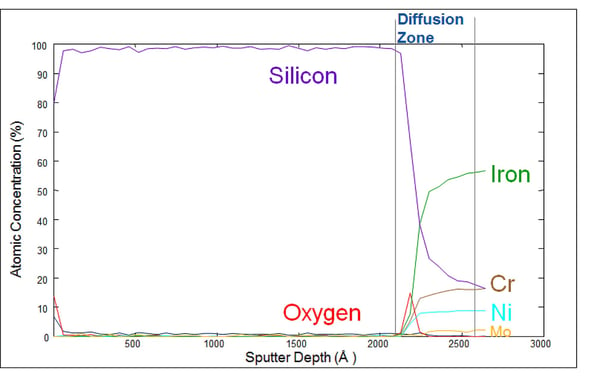
Other coatings, such as Dursan®, incorporate silicon, oxygen, and carbon to achieve different surface properties, but maintain the same fundamental advantage - a uniform, chemically bonded layer that isolates the base material from the process environment. In both cases, the coating is not simply applied on top of the surface, but bonded at the molecular level, forming a consistent interface that does not flake, degrade, or introduce byproducts under normal operating conditions.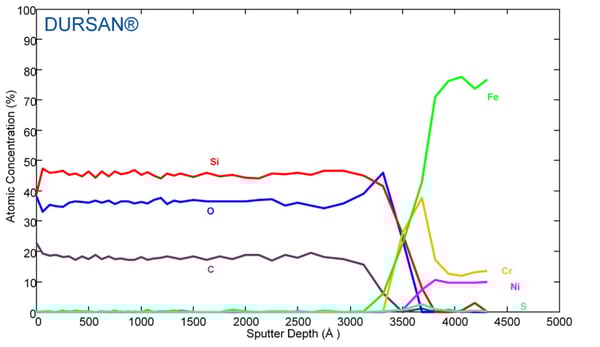
Analytical techniques like Auger Electron Spectroscopy (AES) confirm this structure, showing a defined coating layer and a diffusion zone where the coating is bonded to the substrate. This bonding is key to long-term stability, ensuring the coating remains intact even under elevated temperatures and demanding process conditions.
Final Thoughts
Outgassing is easy to overlook because it isn’t always visible or immediate. Systems may appear to function normally while subtle contamination builds in the background. But in applications where precision matters, these small effects can have a significant impact over time.
Understanding where outgassing comes from - and how to control it - can help transform system performance. It allows analytical instruments to produce more consistent data and semiconductor processes to maintain tighter control over critical variables. In the end, it’s the difference between a system that simply operates and one that performs reliably under the most demanding conditions.
Have questions about coatings for your application? Contact our knowledgeable coating experts today!