Chlorine gas is a challenging environment for metal components, particularly when exposure occurs over extended periods or at elevated temperatures. For industries that rely on stainless steel equipment in corrosive environments, selecting the right surface protection can be critical to maintaining component performance and reducing corrosion related damage.
SilcoTek recently evaluated the performance of four chemical vapor deposition (CVD) coatings under direct exposure to 100% chlorine gas (Cl2). The independent study compared coated samples with uncoated 316L stainless steel and Hastelloy C22 at room temperature and 150°C. The results demonstrate how coating selection can significantly influence corrosion resistance, with Siltride® 1000 and Silcolloy® 1000 showing particularly promising performance under the conditions tested.
For manufacturers considering more expensive corrosion resistant alloys, these findings also highlight another option: applying a protective CVD coating to readily available 316L stainless steel. This approach may provide a more economical path to corrosion protection while allowing manufacturers to retain the benefits of their existing stainless steel components and designs.
Understanding the Challenge of Chlorine Gas Corrosion
Stainless steel is widely used in industrial processing equipment because of its mechanical properties, availability, and general corrosion resistance. However, its ability to withstand aggressive chemical environments depends on the specific conditions of exposure. In applications involving chlorine gas, understanding how a material responds to the process environment is essential when selecting components and protective surface treatments.
SilcoTek's CVD coatings are designed to modify the surface properties of existing components without requiring a complete change in the underlying material. By depositing thin protective layers onto stainless steel and other compatible substrates, these coatings can provide additional resistance to corrosive attack.
Rather than relying exclusively on higher-cost specialty alloys to address corrosion concerns, manufacturers can evaluate whether coated stainless steel provides the surface protection their application requires. This can create opportunities to reduce material expenses while preserving existing component designs and manufacturing processes, particularly when the underlying stainless steel already meets the application's mechanical requirements.
Two of SilcoTek's corrosion resistant coating technologies, Siltride 1000 and Silcolloy 1000, use different surface chemistries to provide protection. Siltride 1000 is based on amorphous silicon oxynitride, while Silcolloy 1000 uses a multilayer amorphous silicon barrier. Both coatings are designed to improve the corrosion resistance of metal surfaces, making them candidates for evaluation in demanding chemical environments.
Putting CVD Coatings to the Test in 100% Chlorine Gas
To better understand coating performance in a chlorine rich environment, an independent laboratory conducted a 168-hour exposure study using a continuous flow of 100% chlorine gas. The study evaluated four SilcoTek coatings: Siltride 1000, Silcolloy 1000, Silcolloy 2000, and Dursan®.
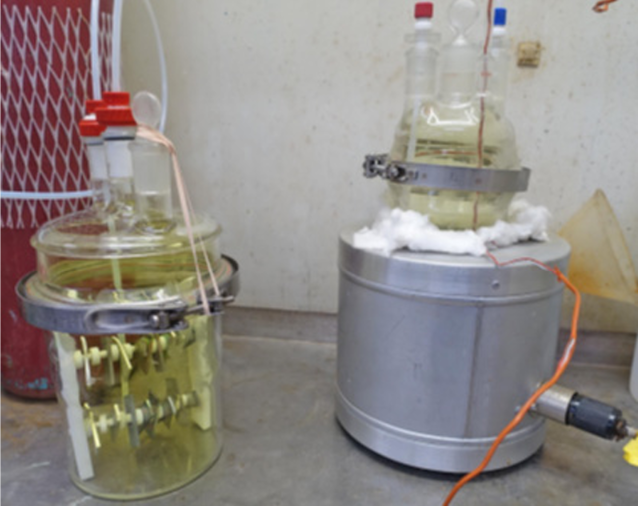 Test vessels used during the independent corrosion study. Coated and uncoated metal samples were exposed to a continuous flow of 100% chlorine gas for 168 hours at room temperature and 150°C.
Uncoated 316L stainless steel and Hastelloy C22 samples were also included to provide a comparison with commonly used metallic materials. Samples were tested at two temperatures, room temperature and 150°C, to examine how exposure conditions influenced corrosion behavior.
Each sample was weighed before and after chlorine exposure, and representative samples underwent scanning electron microscopy with energy dispersive X-ray spectroscopy (SEM-EDS). These analytical techniques allowed researchers to examine surface damage and evaluate the presence of chlorine following exposure.
By combining weight measurements with microscopic surface analysis, the study provided a comparison of how different coating chemistries responded to the same chlorine gas environment.
How Did the Coatings Perform?
The results showed clear differences in corrosion behavior between the uncoated metals and the four SilcoTek coatings. Although the degree of protection varied, the study demonstrated that surface chemistry plays an important role in determining corrosion resistance under the tested conditions.
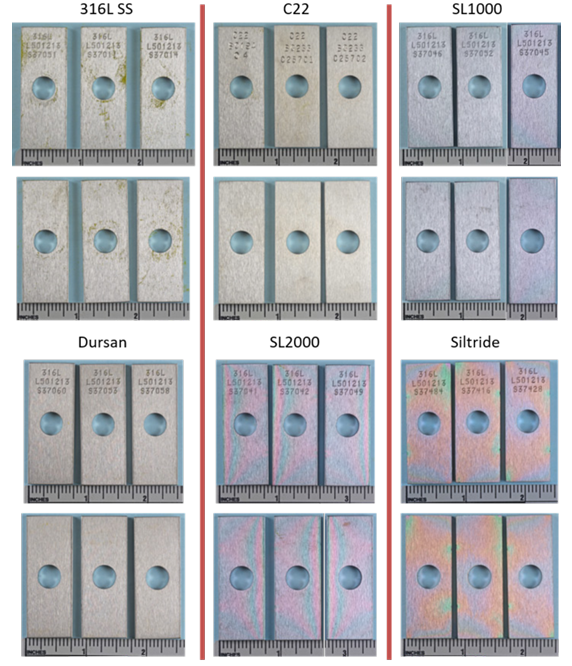 Coated and uncoated metal samples following 168 hours of exposure to 100% chlorine gas at room temperature. Uncoated 316L stainless steel exhibited visible corrosion deposits, while the Siltride 1000 and Dursan samples showed no visible changes. Subsequent microscopic analysis revealed differences not apparent during visual inspection.
Siltride 1000 Demonstrated the Strongest Overall Performance
Of the coatings evaluated, Siltride 1000 exhibited the strongest overall corrosion resistance. Following 168 hours of exposure to 100% chlorine gas, researchers observed no corrosion sites or detectable chlorine uptake on the Siltride 1000 samples at either room temperature or 150°C.
These findings are particularly noteworthy because they demonstrate the coating's performance at both test temperatures. Siltride 1000's amorphous silicon oxynitride chemistry is designed to provide a durable, protective surface with enhanced corrosion resistance.
SilcoTek has also documented Siltride's corrosion resistance in other aggressive chemical environments, including hydrochloric and sulfuric acid exposure. The chlorine gas results provide additional evidence of its protective capabilities under a different set of testing conditions.
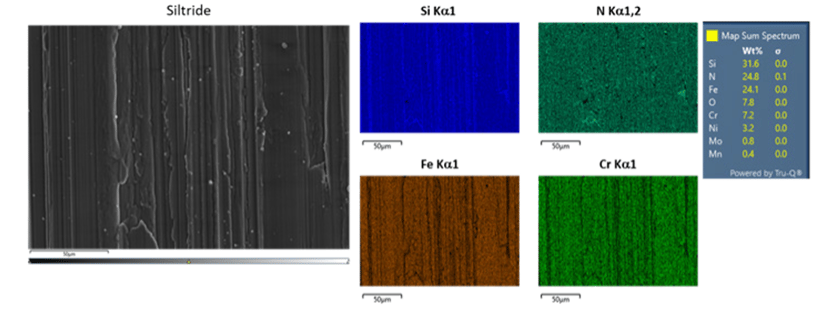 SEM-EDS analysis of Siltride 1000-coated 316L stainless steel following 168 hours of exposure to 100% chlorine gas at room temperature. The coating remained intact, with no detectable corrosion sites or chlorine uptake.
Silcolloy 1000 Provided Strong Corrosion Protection
Silcolloy 1000 was another strong performer in the chlorine gas study, demonstrating the second-best overall performance among the coatings evaluated. Its results were particularly favorable during exposure at 150°C.
Silcolloy 1000 is a multilayer amorphous silicon coating designed to form a protective barrier between the underlying metal and its surrounding environment. SilcoTek uses this coating technology in applications requiring resistance to corrosive chemicals, oxidation, and contamination.
The chlorine gas study adds to SilcoTek's existing corrosion resistance data for Silcolloy 1000 and supports its consideration for applications where metal components may be exposed to aggressive chemical environments.
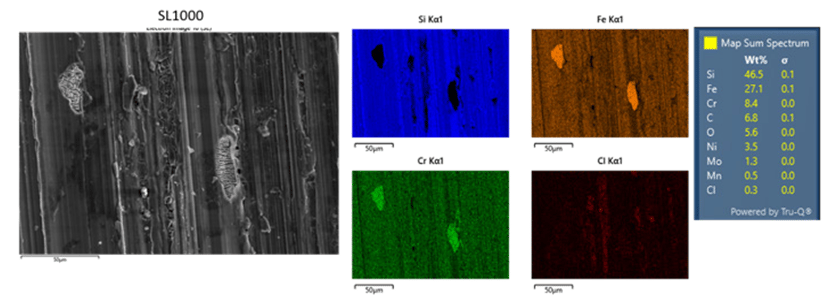
Silcolloy 1000 demonstrated strong corrosion resistance during room temperature chlorine gas testing, with only minor localized corrosion and slight chlorine uptake (0.3%) detected after 168 hours.
Silcolloy 2000 and Dursan Showed Different Responses
The remaining coatings exhibited different levels of protection during the chlorine gas exposure tests. Silcolloy 2000 showed localized corrosion and evidence of chlorine uptake, while Dursan experienced greater chlorine uptake and coating cracking under the conditions evaluated.
These findings highlight an important consideration when selecting protective coatings: performance in one corrosive environment does not necessarily translate to equivalent protection in another. Different coating chemistries offer different surface properties and benefits, making it important to match the coating to the intended operating environment.
Although Dursan and Silcolloy 2000 offer corrosion resistance in other applications, the results of this particular study indicate that Siltride 1000 and Silcolloy 1000 were better suited to the tested chlorine gas conditions.
How Did Uncoated Metals Compare?
The uncoated metal samples provided an important baseline for evaluating the effectiveness of the CVD coatings. Of the materials tested, uncoated 316L stainless steel exhibited the greatest visible corrosion following chlorine exposure at both room temperature and 150°C.
Hastelloy C22 performed better than uncoated 316L stainless steel, although localized corrosion sites were still observed during microscopic examination.
This comparison is particularly valuable for manufacturers weighing the cost of specialty alloys against alternative corrosion protection strategies. Although Hastelloy C22 demonstrated better corrosion resistance than bare 316L stainless steel, it was not completely unaffected by chlorine exposure. Meanwhile, Siltride 1000-coated stainless steel exhibited no detectable corrosion sites or chlorine uptake under either test condition. These results suggest that applying the appropriate CVD coating to a lower-cost stainless steel substrate may offer a compelling alternative to purchasing components manufactured entirely from a higher-cost corrosion resistant alloy.
These results demonstrate why material selection alone may not provide the desired level of protection in every corrosive environment. Applying a compatible CVD coating to an existing metal substrate offers another approach to improving surface corrosion resistance without necessarily changing the component's base material.
For applications where coated stainless steel meets the necessary performance requirements, this approach could help reduce upfront material costs and potentially lower the expense of replacement components. It also gives engineers greater flexibility when balancing corrosion protection, component availability, and overall project budgets.
What Do These Results Mean for Industrial Applications?
The study provides useful information for engineers and manufacturers evaluating surface protection for equipment exposed to chlorine gas. While the results do not establish universal compatibility across all chlorine containing environments, they offer a direct comparison of coating performance under controlled exposure conditions.
The strong performance of Siltride 1000 and Silcolloy 1000 suggests that these technologies are worth considering when evaluating corrosion protection for components exposed to dry chlorine gas under conditions comparable to those in the study.
Beyond corrosion performance, the results introduce an important cost consideration. Specialty alloys such as Hastelloy C22 can increase component material costs, particularly when used throughout an entire assembly. By applying a protective CVD coating to 316L stainless steel, manufacturers may be able to achieve the surface protection needed for certain applications without the expense of manufacturing the entire component from a specialty alloy. The potential savings will depend on component geometry, coating costs, operating conditions, and the performance requirements of the application.
However, coating selection should account for more than chemical exposure alone. Temperature, substrate material, operating conditions, and other process requirements can influence which coating is most appropriate for a particular application.
SilcoTek's Technical Service team can help customers review these factors and identify coating options for further evaluation.
Explore SilcoTek's Chlorine Gas Corrosion Test Results
Protecting metal components from corrosion requires an understanding of both the operating environment and the available surface technologies. SilcoTek's latest chlorine gas corrosion study demonstrates how different CVD coating chemistries perform under controlled exposure to an aggressive chemical environment.
With Siltride 1000 demonstrating the strongest overall performance and Silcolloy 1000 also providing substantial protection, the results offer valuable insight into selecting corrosion resistant coatings for challenging applications.
With Siltride 1000 demonstrating the strongest overall performance and Silcolloy 1000 also providing substantial protection, the results highlight the potential value of SilcoTek's CVD coatings as an alternative to more expensive specialty alloys. Under the conditions evaluated, Siltride 1000-coated 316L stainless steel exhibited no detectable corrosion sites or chlorine uptake, while uncoated Hastelloy C22 showed localized corrosion. For manufacturers seeking to balance corrosion resistance with material costs, SilcoTek-coated stainless steel offers an option worth evaluating. By combining the affordability and availability of stainless steel with the surface protection of a specialized CVD coating, manufacturers may be able to reduce material expenses without sacrificing the corrosion performance required for their application.
Interested in improving corrosion resistance for your components? Contact SilcoTek's Technical Service team to discuss your application and determine which CVD coating may be the best fit.