When scientists, researchers, engineers, or any other users evaluate materials or surface treatments for demanding applications, hardness is often one of the first properties considered. It is easy to measure, widely reported, and commonly associated with durability. However, real-world performance data consistently shows that hardness alone does not determine how long a coating will last in service. In many cases, coatings with lower measured hardness outperform harder alternatives when subjected to friction, sliding contact, or abrasion.
Understanding the distinction between hardness and wear resistance (and how each is measured) is essential for making informed coating decisions.
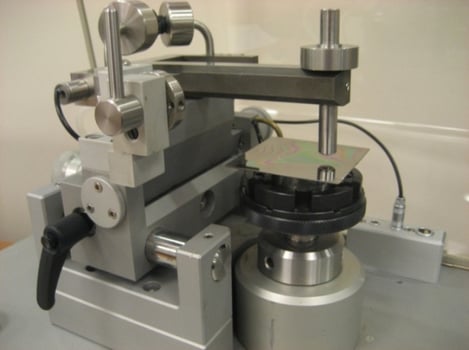
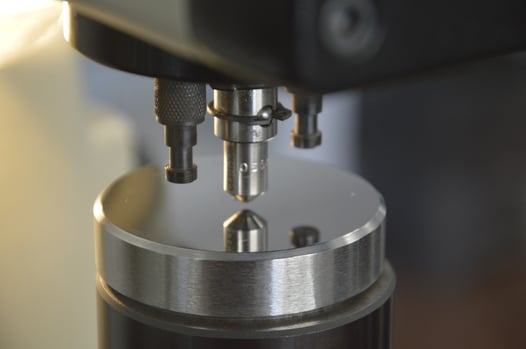
Left: Pin-on-disc testing equipment used to measure wear performance. Right: Vickers hardness testing equipment used to measure hardness.
What Hardness Actually Measures
Hardness describes a material’s resistance to permanent deformation when a force is applied perpendicular to its surface. In practice, hardness is determined using indentation-based tests such as Rockwell, Vickers, or, for thin films and coatings, nanoindentation.
Nanoindentation uses a precisely controlled diamond tip to press into a coating surface while measuring load and displacement. From this data, hardness and elastic modulus values are calculated. These measurements are useful for comparing resistance to scratching or indentation under static loading conditions, but they represent a very specific type of mechanical interaction.
What hardness does not measure is how a surface behaves when forces are applied repeatedly, when motion is involved, or when shear forces dominate - all of which are common in real applications.
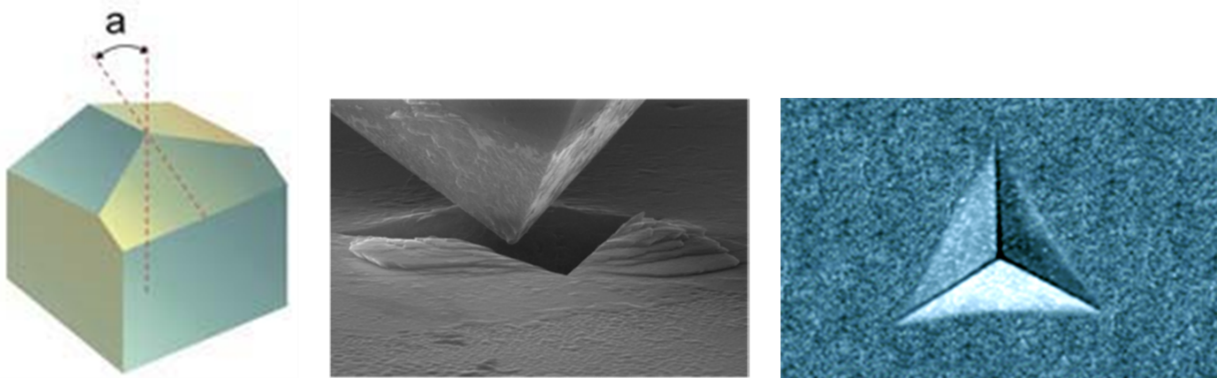 A Berkovich tip, used in nanoindentation, with “a” denoting the half angle, and the indentation shape it leaves on the surface of the testing specimen
Wear Resistance Is a Performance Outcome, Not a Single Property
Wear resistance describes how well a surface withstands material loss over time due to friction, sliding, abrasion, or contact with other materials. Unlike hardness, wear resistance is not a fundamental material property. It is the result of several interacting factors, including hardness, toughness, adhesion to the substrate, friction coefficient, and elastic response.
Because wear involves both perpendicular and parallel forces, it must be evaluated using dynamic tests that simulate motion. One of the most common methods is pin-on-disk testing, where a stationary pin is pressed against a rotating surface under controlled load. The resulting wear track and material loss provide direct insight into how a coating performs under tribological conditions.
Why Hardness and Wear Resistance Often Diverge
It is tempting to assume that increasing hardness will always improve wear resistance, but testing repeatedly shows that this relationship is not linear. Hard coatings can be brittle. Under sliding contact, they may crack, fracture, or delaminate if adhesion or toughness is insufficient. Once the coating fails locally, wear can accelerate rapidly.
Softer or moderately hard coatings, on the other hand, may better absorb stress, maintain adhesion, and reduce friction at the contact interface. In these cases, lower hardness does not indicate inferior performance - it reflects a different balance of mechanical properties that may be better suited for wear-intensive environments.
This distinction explains why materials such as rubber, despite being relatively soft, can exhibit excellent wear resistance in dynamic applications.
What SilcoTek’s Coating Data Shows
Hardness testing of several SilcoTek coatings using nanoindentation shows clear differences in indentation resistance. Silcolloy® 1000 exhibits the highest hardness among the coatings tested, followed by experimental formulations such as Siltride® 1000. Dursan®, while still harder than uncoated stainless steel, measures significantly lower in hardness than Silcolloy.
When these same coatings are evaluated using pin-on-disk wear testing, the performance ranking changes. In multiple wear studies, Dursan consistently demonstrates lower wear rates than harder coatings like Silcolloy 1000. More recent testing that includes additional coatings shows that Siltride 1000, a silicon oxynitride coating, offers some of the best wear resistance across a range of applied loads, despite not being the hardest coating in the group.
These results reinforce an important point: hardness alone does not predict wear performance. Coatings with strong adhesion, lower friction, and favorable elastic behavior often outperform harder coatings in sliding or abrasive environments.
Why Siltride 1000 Changes the Hardness vs. Wear Conversation
While hardness is often used as a shorthand for durability, SilcoTek’s testing shows that Siltride challenges the assumption that harder coatings always wear better. Siltride is not positioned as a traditional “hard coating,” yet it consistently demonstrates strong wear resistance under sliding contact due to its surface chemistry, adhesion, and mechanical resilience.
Siltride is a silicon oxynitride coating engineered to provide a chemically inert, conformal barrier while maintaining excellent mechanical integrity. Rather than maximizing hardness alone, the coating balances moderate hardness with low friction behavior and strong adhesion to metallic substrates. This balance plays a significant role in its performance during wear testing.
This distinction is important because most real applications involve motion, repeated contact, and mixed loading conditions, not static indentation.
The Role of Friction, Adhesion, and Elasticity
Wear resistance depends heavily on how a coating interacts with its environment. A lower coefficient of friction reduces the mechanical energy dissipated at the surface, slowing material loss. Strong adhesion between the coating and substrate prevents delamination under repeated stress. Elastic compliance allows the coating to accommodate contact forces without cracking.
These factors are not captured by hardness measurements, yet they dominate real-world wear behavior. This is why coatings designed for corrosion resistance or cleanliness can also perform exceptionally well in wear applications when their surface chemistry and mechanical properties are well balanced.
Check out this (old, but still relevant) video of a SilcoTek coating demonstration showing how our coatings will not flake off:
Implications for Coating Selection
When selecting a coating, it is important to match test data to application conditions. Hardness values can be useful for understanding scratch resistance or resistance to deformation, but they should not be used solely when wear is a concern.
Applications involving sliding contact, repeated motion, or abrasion benefit more from wear testing data that reflects actual service conditions. In these cases, wear resistance, not hardness, is the more relevant metric for predicting service life and reliability.
Real-World Examples: Durability Beyond Hardness
Several long-term applications highlight why focusing solely on hardness can be misleading.
In pharmaceutical manufacturing environments, Dursan coatings have demonstrated long-term robustness while withstanding aggressive sanitary cleaning procedures used by Abbott. Despite not being marketed as a hard or wear-optimized coating, Dursan maintains surface integrity through repeated exposure to cleaning chemicals, thermal cycling, and mechanical handling.
In another example, Dursan has proven durable on process sampling probes in a power generation facility, where components are exposed to a combination of corrosive gases, sticky byproducts, and physical abrasion. In this case, chemical inertness, adhesion, and surface stability were more critical to service life than maximum hardness.
These examples underscore a broader lesson: successful coating performance is application-driven, not number-driven.
Conclusion
Hardness and wear resistance describe different aspects of material behavior. Hardness measures resistance to indentation under static loading, while wear resistance reflects how a surface performs over time under motion and friction.
SilcoTek’s coating test data shows that the most wear-resistant coatings are not always the hardest. Instead, they are the ones that combine adequate hardness with strong adhesion, low friction, and mechanical resilience. For engineers and designers, the key takeaway is clear: selecting coatings based on performance data, not just a single hardness value, leads to better outcomes in real-world applications.
Have questions about your applications? Contact our knowledgeable coating experts today!
Follow Us on Social Media!