Customers often ask whether SilcoTek coatings are electrically conductive or insulating. The answer depends on the coating chemistry, structure, and application environment.
While SilcoTek coatings are best known for inertness and corrosion resistance, they also play a role in electrical insulation and dielectric performance. In many applications these coatings are not used to carry current, but to control, resist, or stabilize it. They are not usually used primarily for this purpose, but rather in addition to the other properties of SilcoTek coatings.
Conductive or Insulating? It Depends on the Coating
SilcoTek coatings are not designed to function as electrical conductors. Instead, they behave primarily as dielectric materials, resisting current flow and helping maintain electrical stability in demanding environments.
Three coatings are especially relevant when evaluating electrical performance:
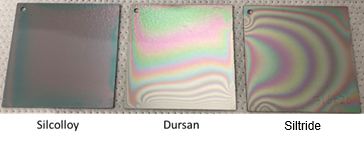
- Silcolloy® – an amorphous silicon coating optimized for high-temperature and corrosive environments (semiconducting)
- Dursan® – a silica-based coating engineered for well-balanced inertness, fouling release, and corrosion resistance (dielectric)
- Siltride® – a silicon nitride-based coating designed for enhanced corrosion resistance and wear resistance (dielectric)
All three have been characterized for dielectric properties by the Penn State University Dielectric Properties Lab, providing a strong foundation for comparison.
The Electrical Properties That Actually Matter
To understand how these coatings behave electrically, three key properties are evaluated:
Bulk Resistivity
Bulk resistivity measures how strongly a material resists electrical current.
- Silcolloy: ~10⁸ Ω·cm
- Dursan: ~10¹² Ω·cm
- Siltride: ~10¹³ Ω·cm
This shows a clear trend: Siltride provides the highest resistance to current flow, making it the strongest insulator of the three.
Relative Permittivity (Dielectric Constant)
Permittivity reflects how well a material stores electrical energy.
- Silcolloy: higher than typical amorphous silicon due to composition differences
- Dursan: higher than standard SiO2 due to carbon incorporation
- Siltride: falls within the expected range for silicon nitride materials
Each coating offers a different balance between energy storage and insulation.
Dielectric Loss (Energy Dissipation)
Loss tangent measures how much energy is lost as heat.
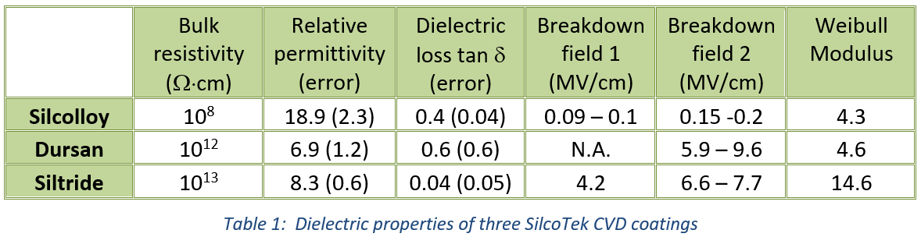
Lower loss means better efficiency and less energy dissipation - another area where Siltride stands out.
Dielectric Breakdown Strength
Breakdown strength defines how much voltage a coating can withstand before failure.
Both Dursan and Siltride exhibit strong dielectric strength approaching traditional insulating materials like silicon dioxide and silicon nitride. Siltride, in particular, shows high and consistent breakdown performance, making it promising for advanced electrical applications.
Why Siltride Stands Out Electrically
While Dursan is often the go-to for insulation today, Siltride introduces a new level of performance.
Compared to both Silcolloy and Dursan, Siltride offers:
- Higher bulk resistivity (better insulation)
- Lower dielectric loss (greater efficiency)
- Strong and consistent breakdown behavior
Testing shows that Siltride outperforms both coatings in key dielectric metrics, positioning it as a next-generation solution for applications where coatings and electrical performance are critical.
What Impacts Electrical Performance in the Real World
One of the most important insights from dielectric testing is that performance depends on more than just coating chemistry.
Coating Thickness
Thicker films generally improve insulation reliability, especially on rough surfaces.
Surface Roughness and Substrate
Because these coatings are thin, the underlying material strongly influences performance. Rough surfaces may require thicker coatings to ensure consistency.
Defects and Film Quality
All dielectric materials contain microscopic defects. However, SilcoTek coatings exhibit self-clearing behavior, where localized breakdown events do not immediately lead to total failure. This “graceful failure” mechanism allows the coating to continue functioning even after minor dielectric events.
What This Means for Your Application
In practice, SilcoTek coatings are not used to enhance conductivity. Instead, they are selected to:
- Provide electrical insulation in sensitive systems
- Reduce current leakage and energy loss
- Maintain signal integrity in analytical instrumentation
- Deliver stable performance in harsh chemical or high-temperature environments
In many applications, the coating serves a dual purpose - protecting the surface chemically while also stabilizing electrical behavior.
Final Thoughts
SilcoTek coatings offer more than just inertness, they create a controlled electrical environment that improves system reliability and performance.
While Silcolloy and Dursan remain strong, proven solutions, Siltride represents a step forward in dielectric performance, offering higher resistivity, lower loss, and enhanced reliability for electrically demanding applications.
If you have any questions about how our coatings can help in your application, please contact us for a free consultation with our experts!