In analytical and process sampling systems, the sample often travels through numerous components before it reaches the detector. Each surface along that route can potentially interact with the sample.
An inert flow path is designed to minimize those interactions throughout the entire sample pathway. This helps prevent sensitive compounds from adsorbing to or reacting with exposed metal surfaces before they can be measured.
Creating an inert flow path requires more than treating one length of tubing. Tubing, fittings, valves, regulators, filters, sample cylinders, and instrument components may all come into contact with the sample. If even one of these surfaces remains reactive, it may affect analytical performance.
Why Can an Untreated Flow Path Cause Problems?
Stainless steel offers the strength and durability required by many analytical systems. However, untreated stainless steel can adsorb reactive compounds, particularly during trace-level analysis.
Sulfur compounds, volatile organic compounds, ammonia, mercury, and other sensitive substances may interact with untreated metal surfaces. These interactions can prevent the complete sample from reaching the detector or delay the system’s response.
According to SilcoTek testing and published studies featured on SilcoTek.com, reactive flow path surfaces may contribute to problems such as:
- Sample adsorption
- Delayed response
- Reduced compound recovery
- Peak distortion
- Calibration difficulties
- Increased system maintenance
- False positive or false negative results
These effects can be particularly important when measuring compounds at parts-per-million or parts-per-billion concentrations.
What Components Make Up a Flow Path?
The flow path includes every surface the sample contacts during collection, storage, transport, and analysis. Depending on the application, these surfaces may include:
- Sample probes
- Tubing
- Fittings
- Valves
- Pressure regulators
- Mass flow controllers
- Fritted and in-line filters
- Sample cylinders and canisters
- Instrument inlets
- GC and GC-MS components
- Columns and transfer lines
It can be easy to focus on larger or more visible components, such as tubing and sample cylinders. However, smaller components can also introduce reactive surfaces.
SilcoTek has demonstrated this effect using hydrogen sulfide testing performed with coated and uncoated regulators. The comparison showed that a single uncoated regulator could significantly delay system response. This means that replacing or coating the tubing alone may not solve an adsorption problem if the sample still encounters an untreated valve, fitting, filter, or regulator.
How Are Inert Flow Paths Created?
SilcoTek uses chemical vapor deposition, or CVD, to apply thin silicon coatings to stainless steel and other compatible materials.
CVD is a non-line-of-sight process. Treatment gases circulate through the coating chamber and contact exposed surfaces, allowing the coating to reach narrow passages and complex internal geometries. SilcoTek routinely coats parts such as tubing, fittings, valves, regulators, filters, weldments, columns, and other intricate components.
The resulting coating is less than 3 µm thick and bonds to the underlying substrate. Because it is thin and conformal, it can modify the sample-contacting surface without significantly changing the dimensions or function of the component.
How Does SilcoNert 2000 Improve Flow Path Inertness?
SilcoNert® 2000 is an amorphous silicon coating functionalized to improve inertness in trace-level gas sampling and chromatography applications. It creates a barrier between the sample and reactive sites on the underlying metal.
This surface can help prevent adsorption and unwanted chemical reactions while retaining the mechanical benefits of stainless steel.
SilcoNert 2000 is commonly used for applications involving:
- Sulfur compounds
- Volatile organic compounds
- Ammonia
- Mercury
- Refinery and petrochemical gases
- Environmental and emissions samples
- Specialty gases
Its performance has been evaluated using several reactive compounds, including methanol and hydrogen sulfide.
What Does VOC Testing Show?
A study featured on SilcoTek.com compared 10-meter lengths of SilcoNert 2000-coated and uncoated stainless steel tubing. Researchers passed a 180 µmol/mol methanol mixture through the tubing and measured the time required to reach the baseline concentration.
The SilcoNert 2000-coated tubing stabilized in less than one minute. The uncoated stainless steel tubing required more than 40 minutes.
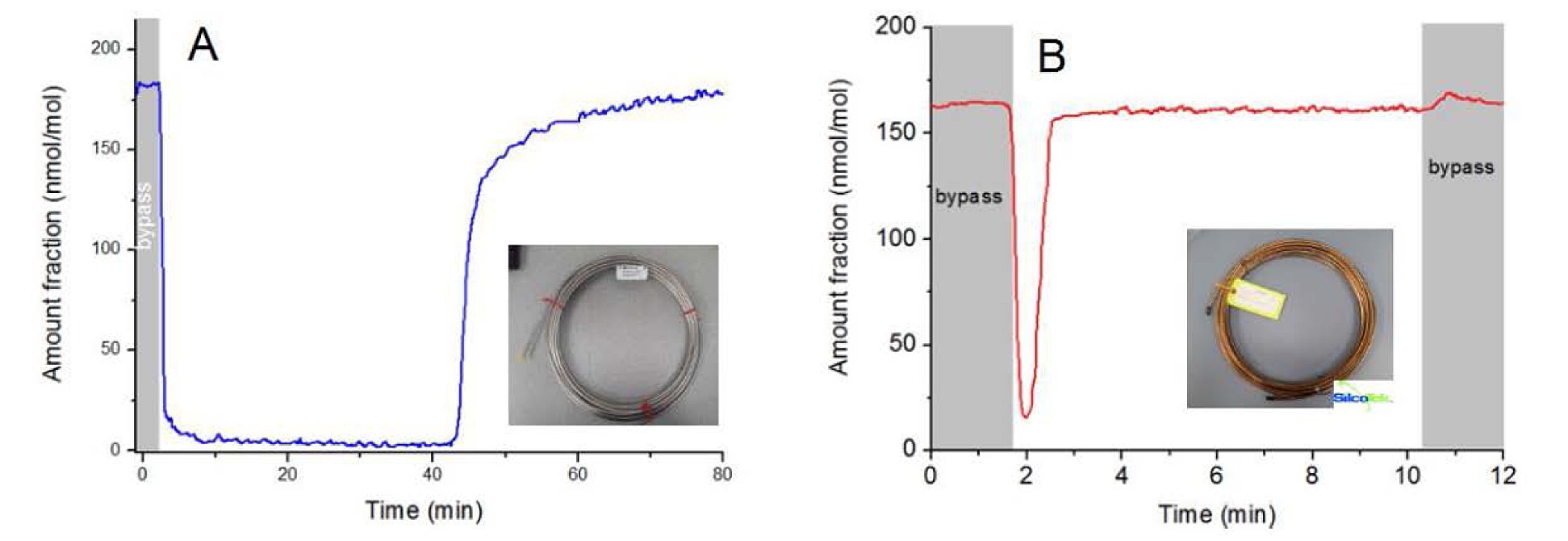
This comparison demonstrates how adsorption on an untreated metal surface can delay the transport and measurement of a reactive compound. It also shows why surface selection is important throughout a trace VOC sampling system.
Why Does the Entire Flow Path Matter?
An analytical system is only as inert as the surfaces that contact the sample. Coating a sample cylinder or long section of tubing may provide limited improvement if the sample must still pass through an untreated regulator, valve, filter, or fitting.
When evaluating a flow path, consider each stage of the process:
- Where is the sample collected?
- Is the sample stored before analysis?
- Which components transport or control the sample?
- Does the sample pass through a filter or regulator?
- Which instrument surfaces contact the sample before detection?
Reviewing the complete pathway can help identify surfaces that may contribute to adsorption, slow response, or inconsistent recovery.
Building a More Reliable Sampling System
Creating an inert flow path is a system-wide approach to protecting sample integrity. It requires considering every surface the sample contacts rather than concentrating on one individual component.
SilcoNert 2000-coated tubing, fittings, valves, regulators, filters, sample cylinders, and instrument components can be combined to reduce unwanted surface interactions throughout the sample pathway.
Contact SilcoTek to discuss your sample chemistry, operating conditions, component materials, and flow path requirements.